Strides of March Caps Indoor Season with 238 Athletes

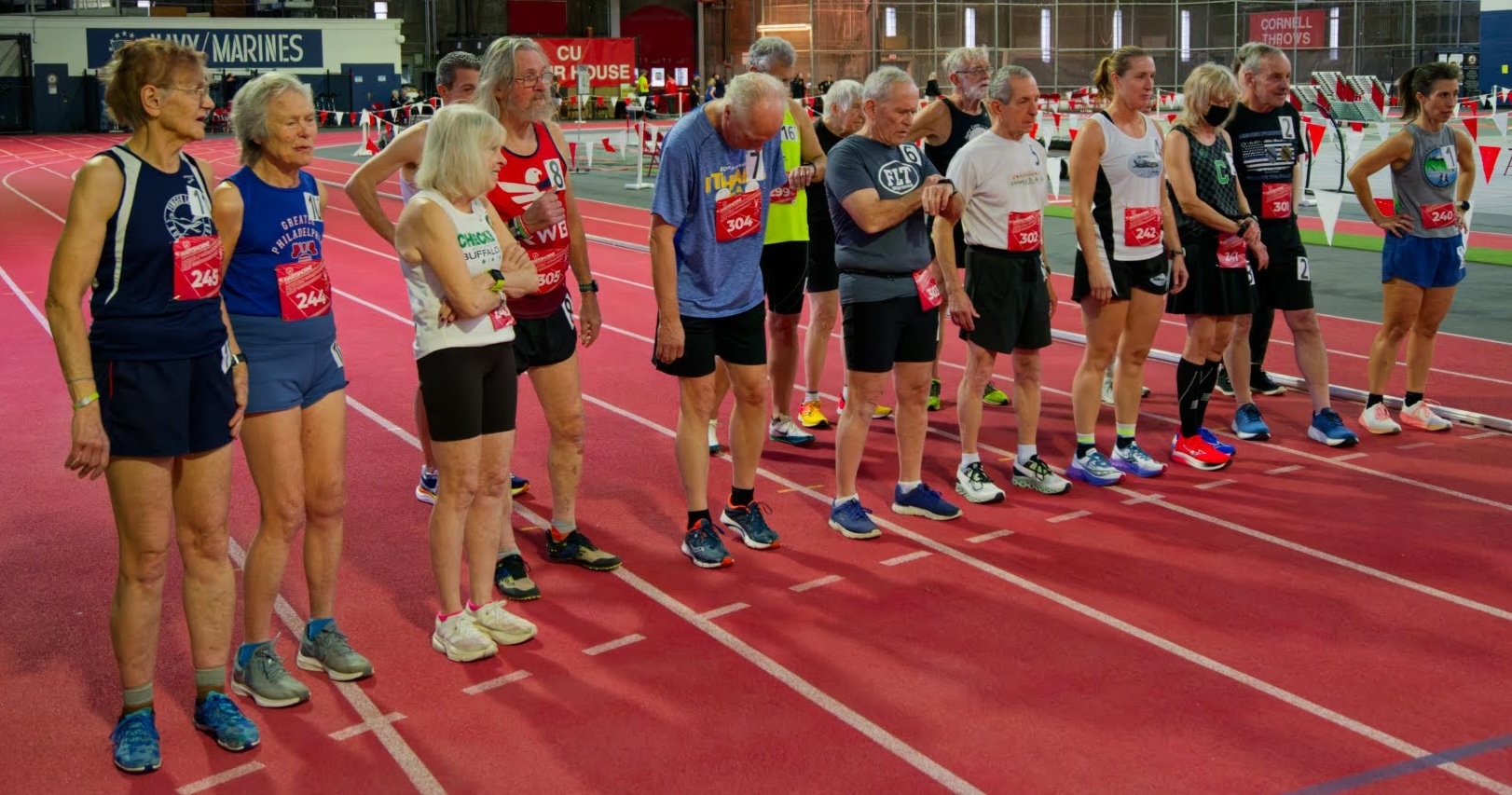
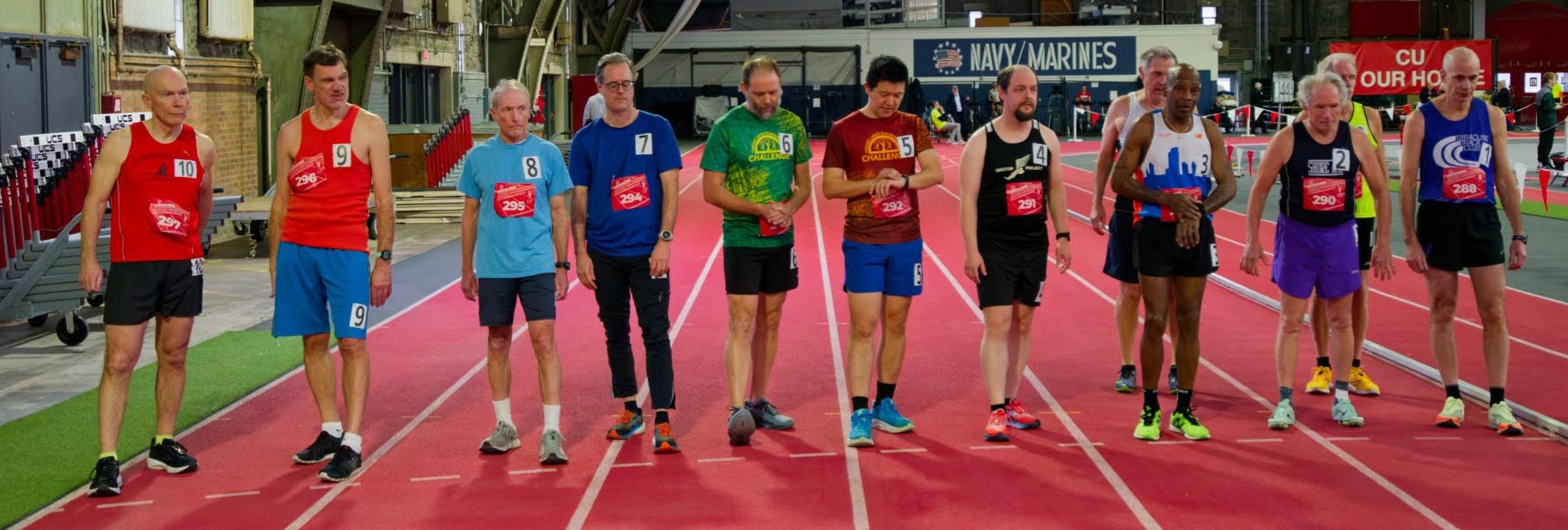
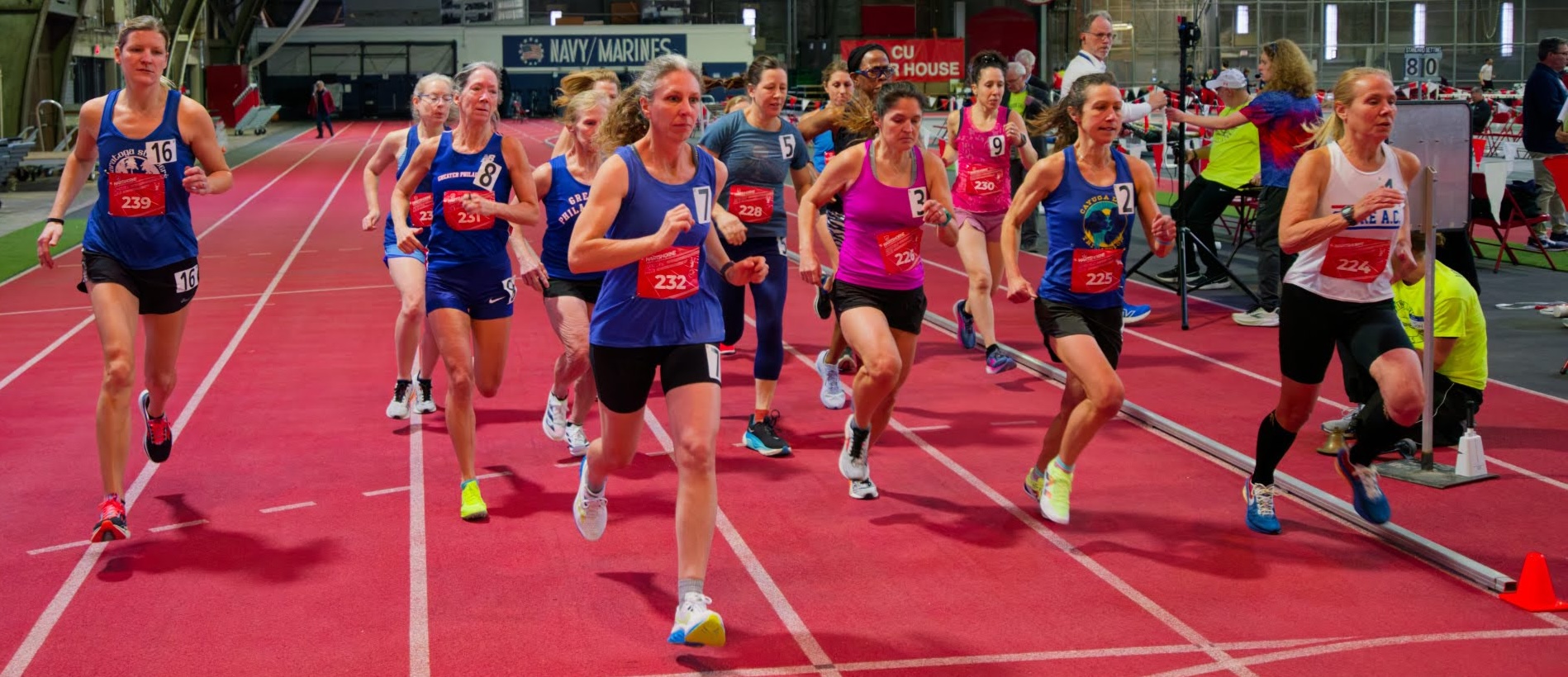
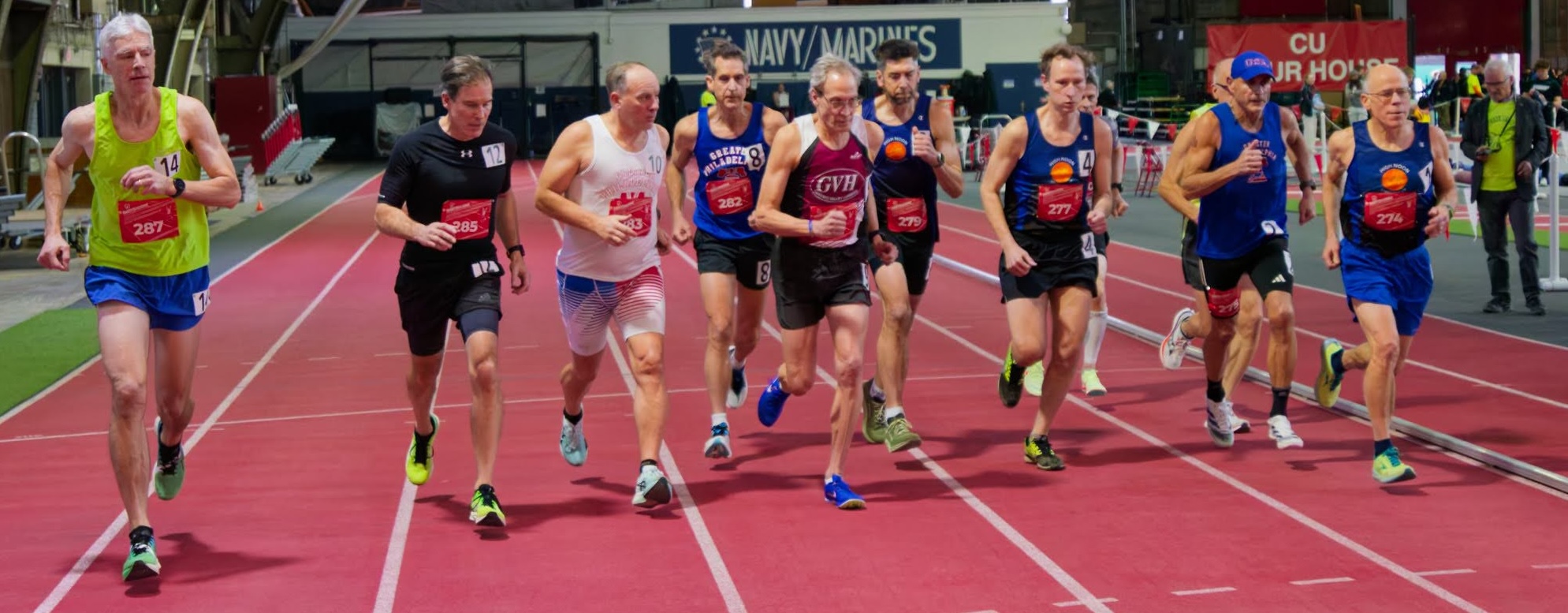
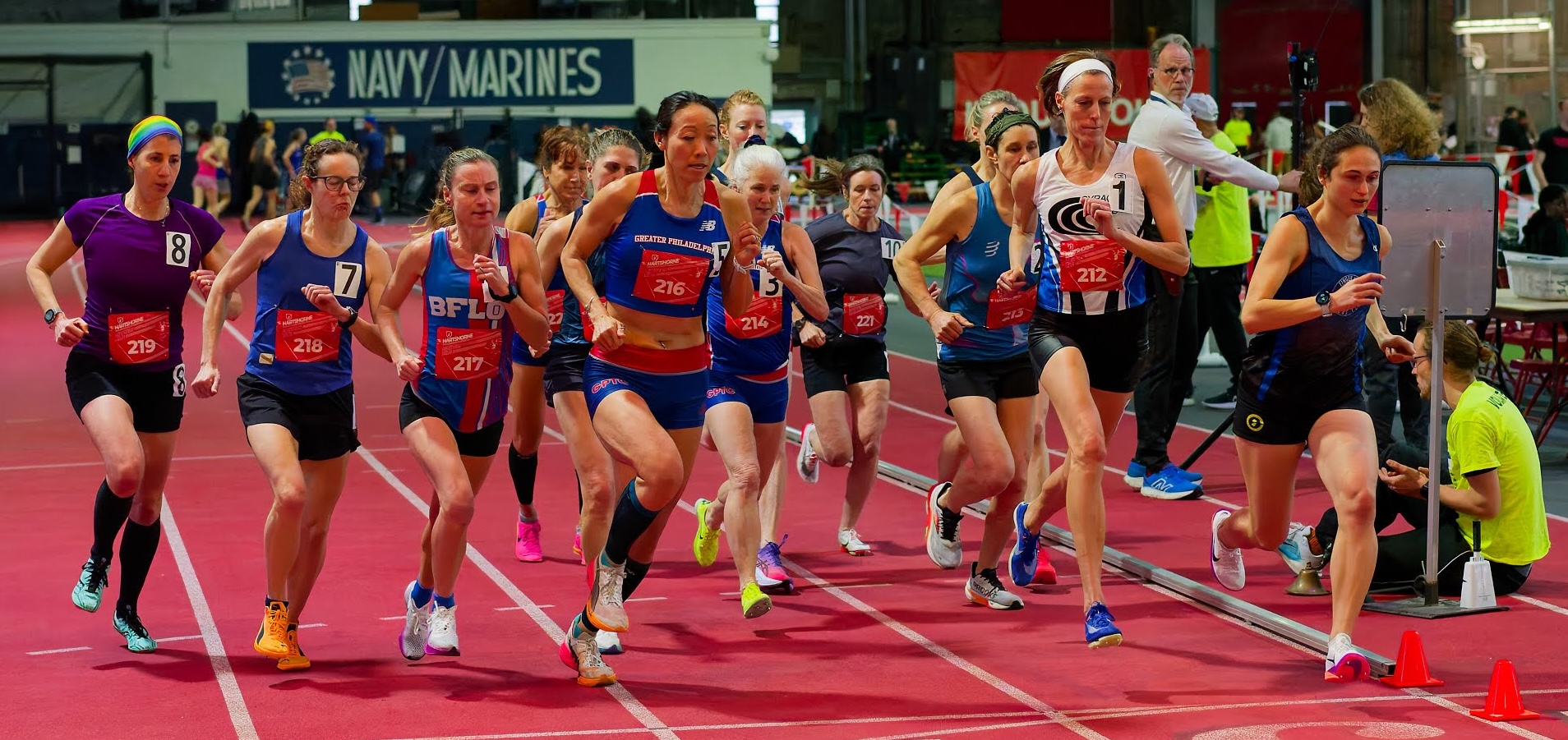
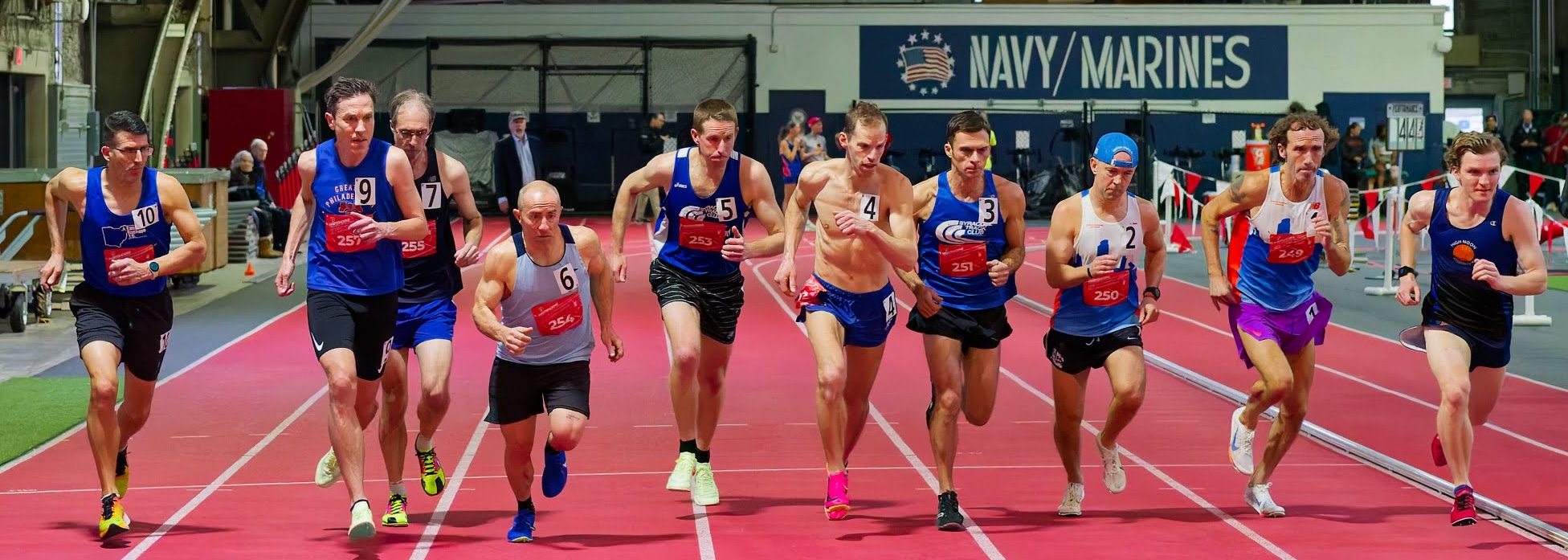
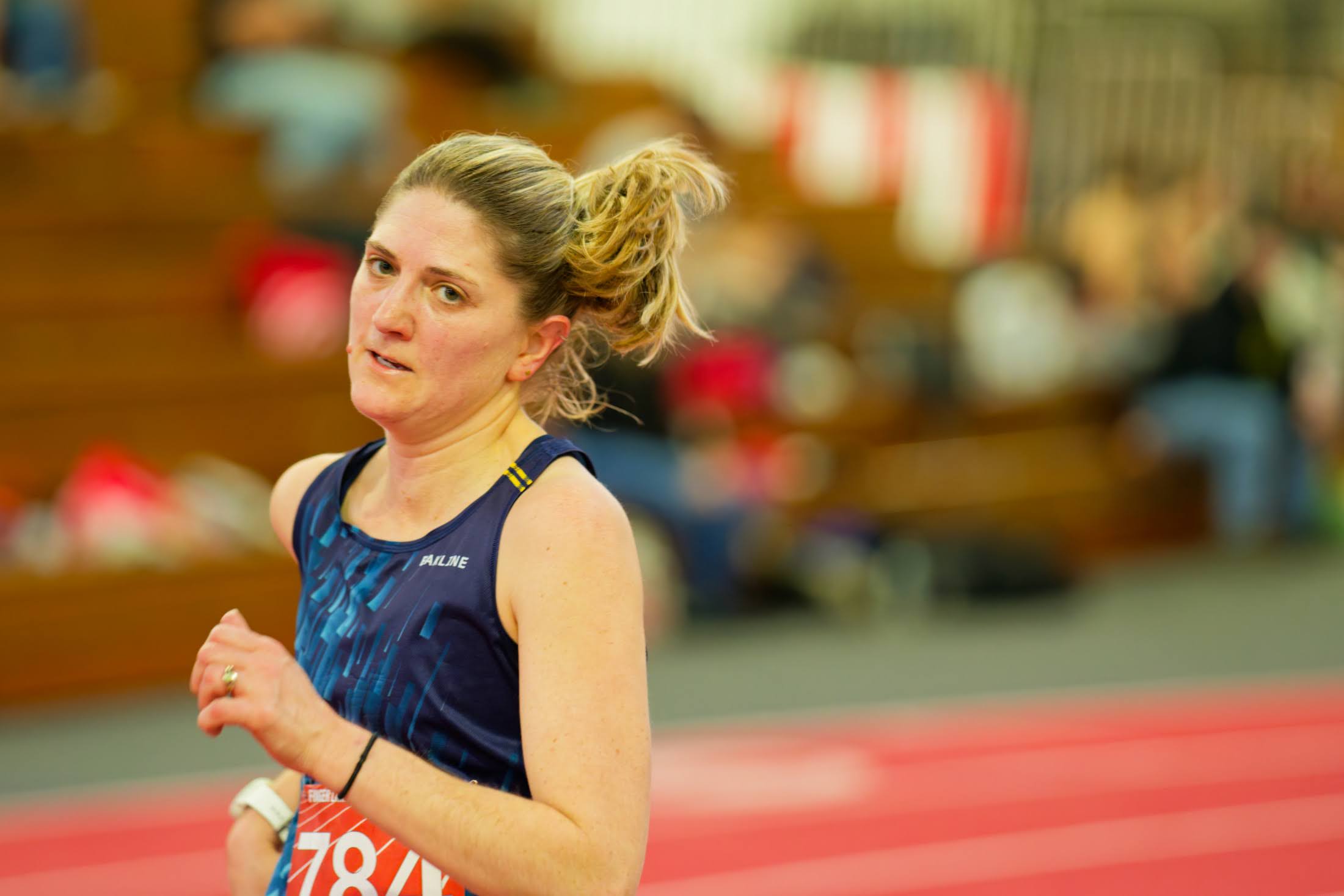
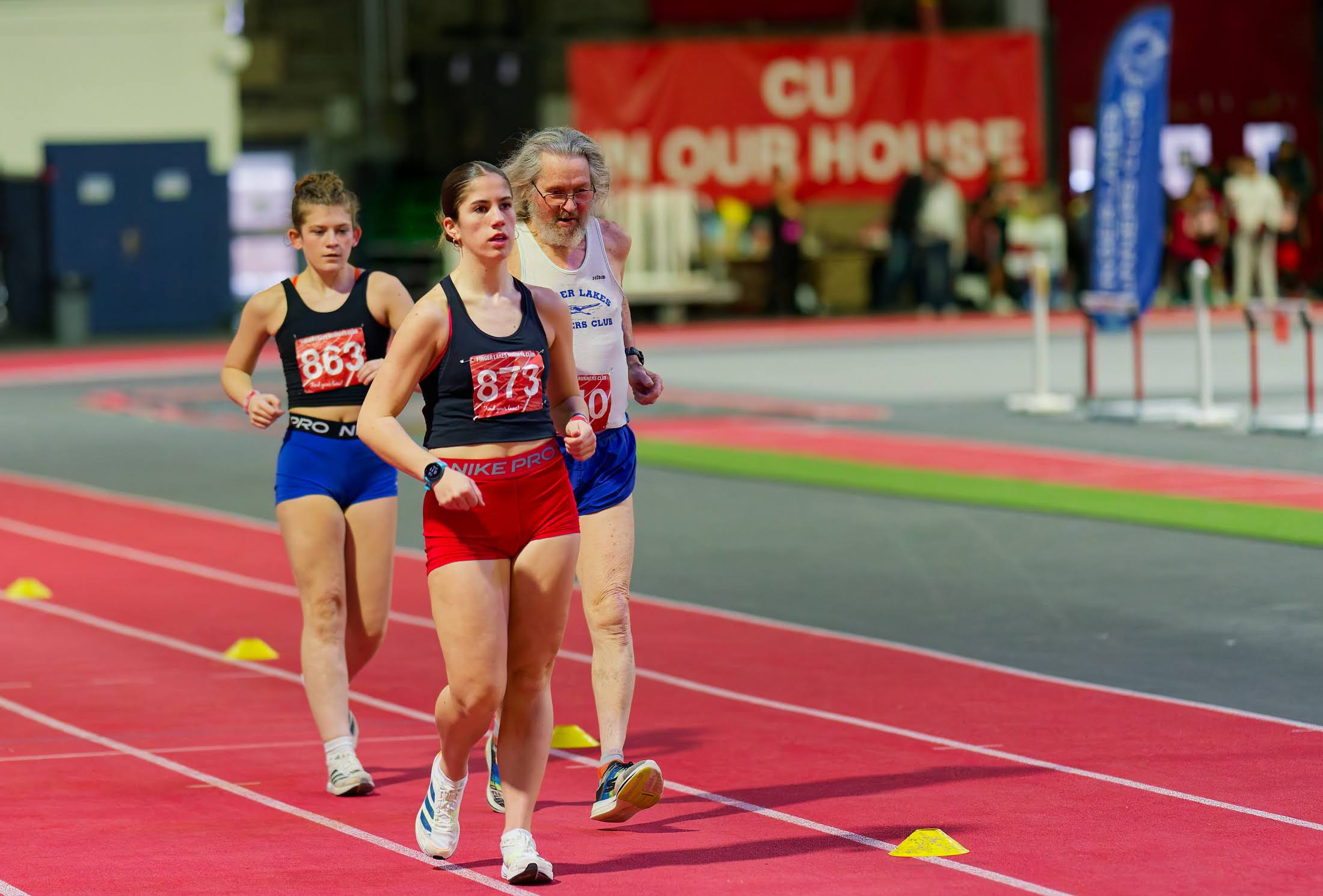
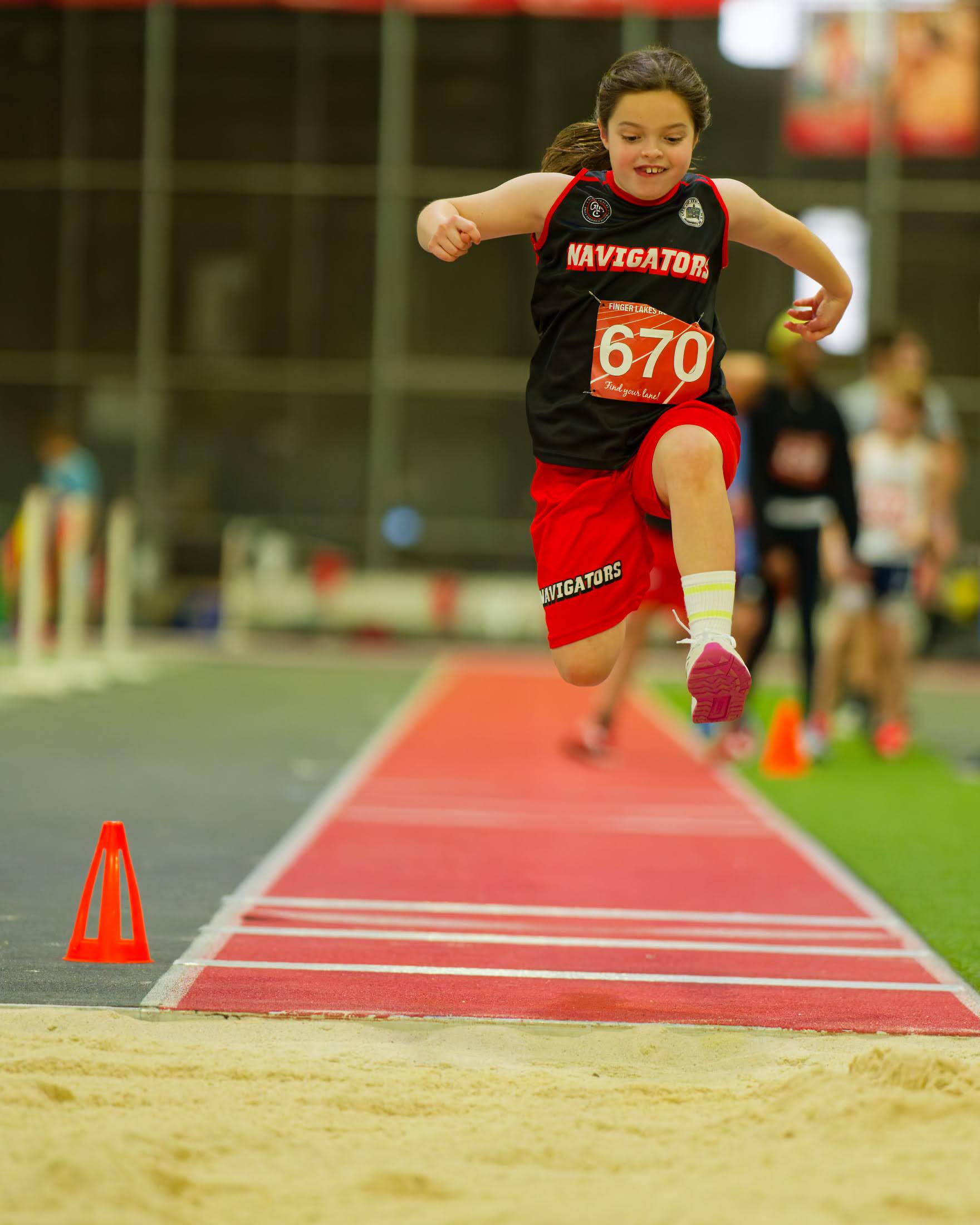
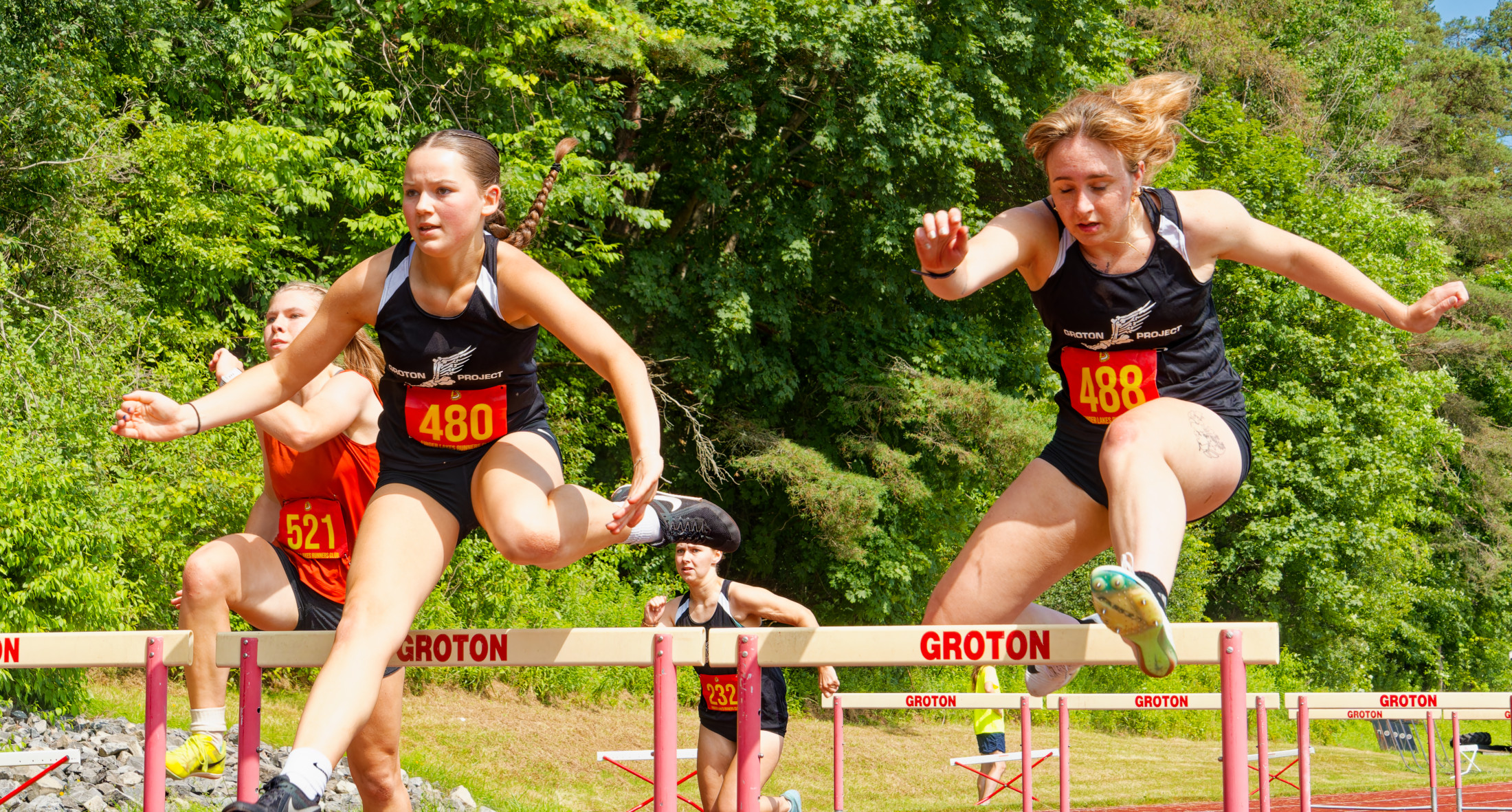
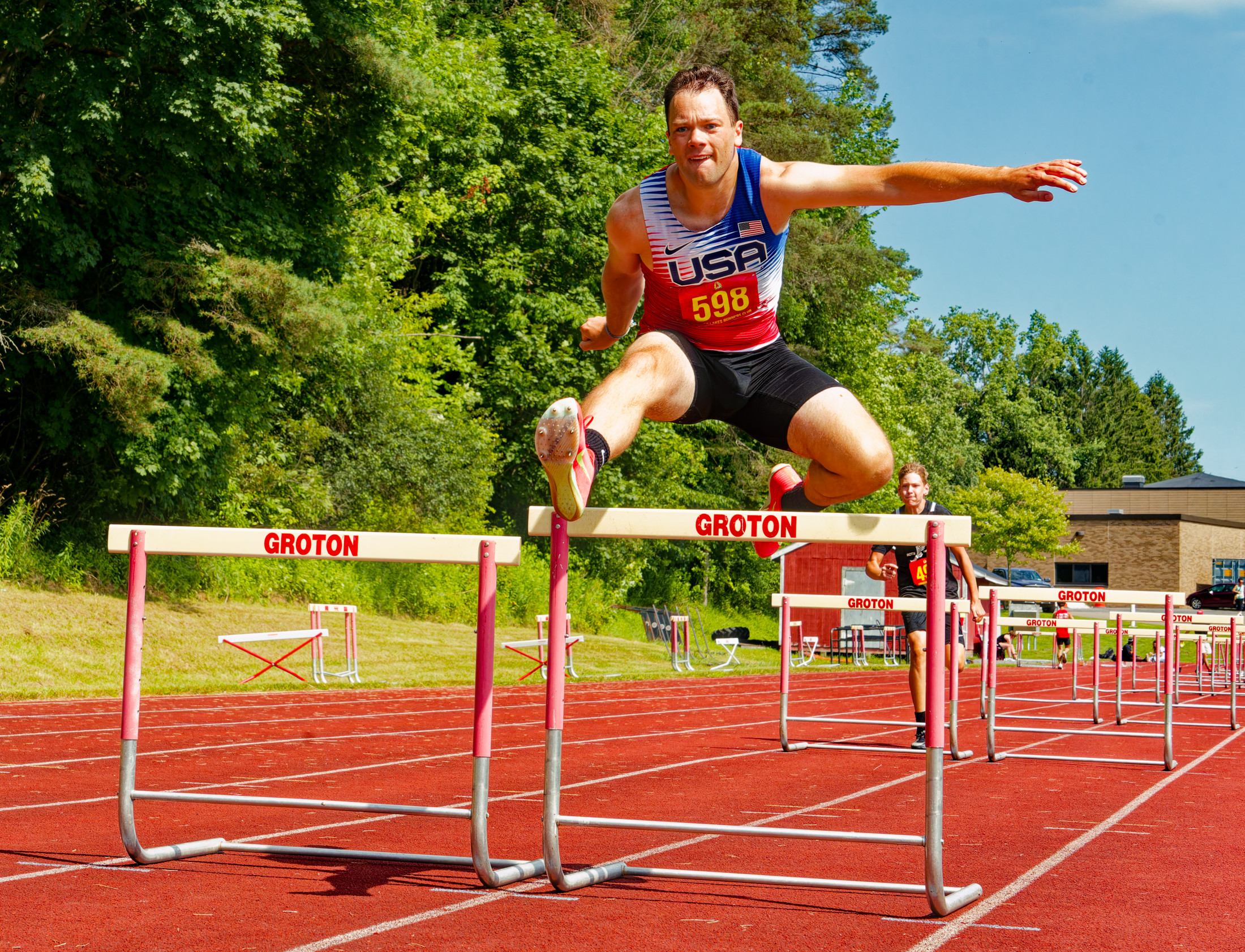
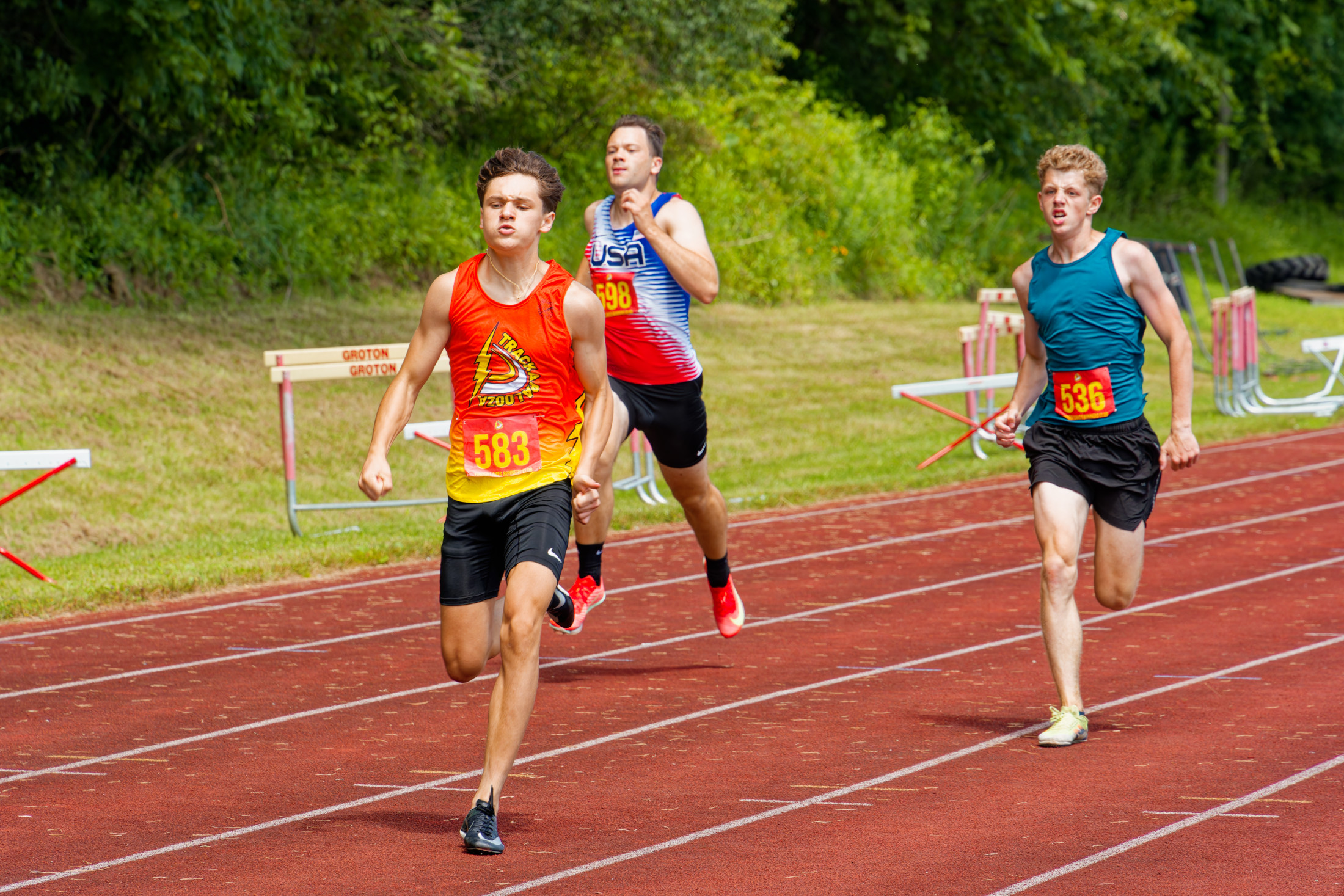
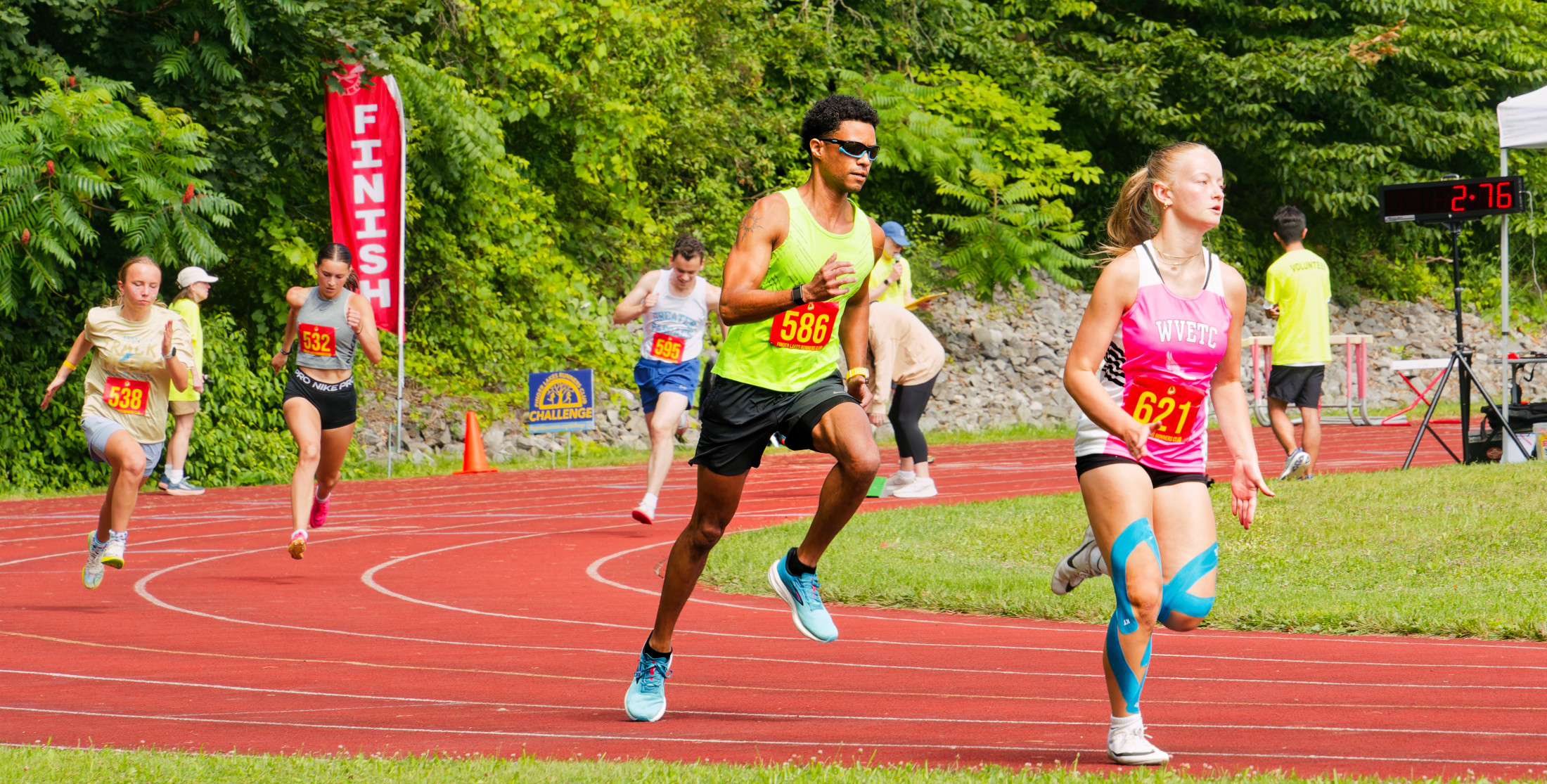
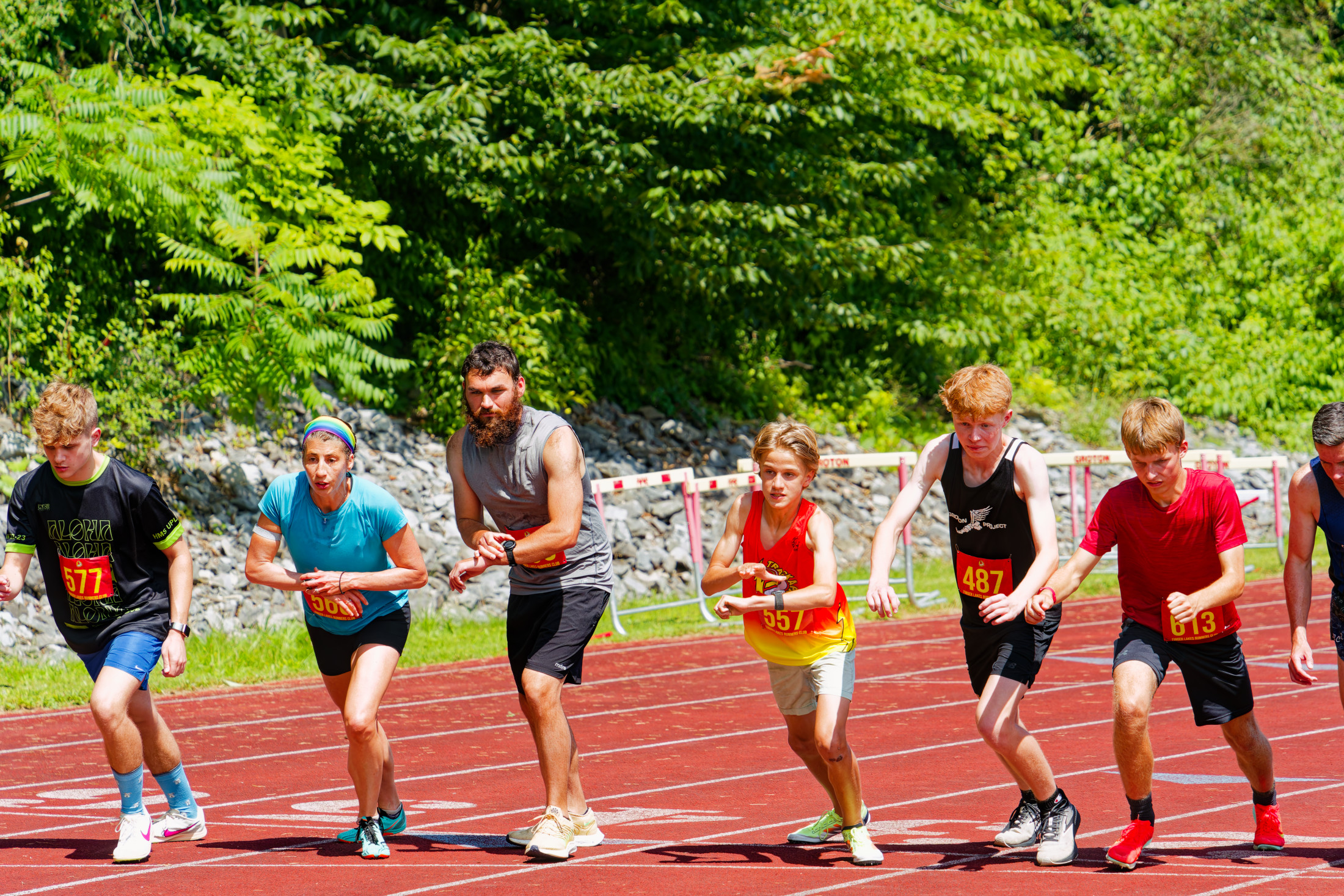
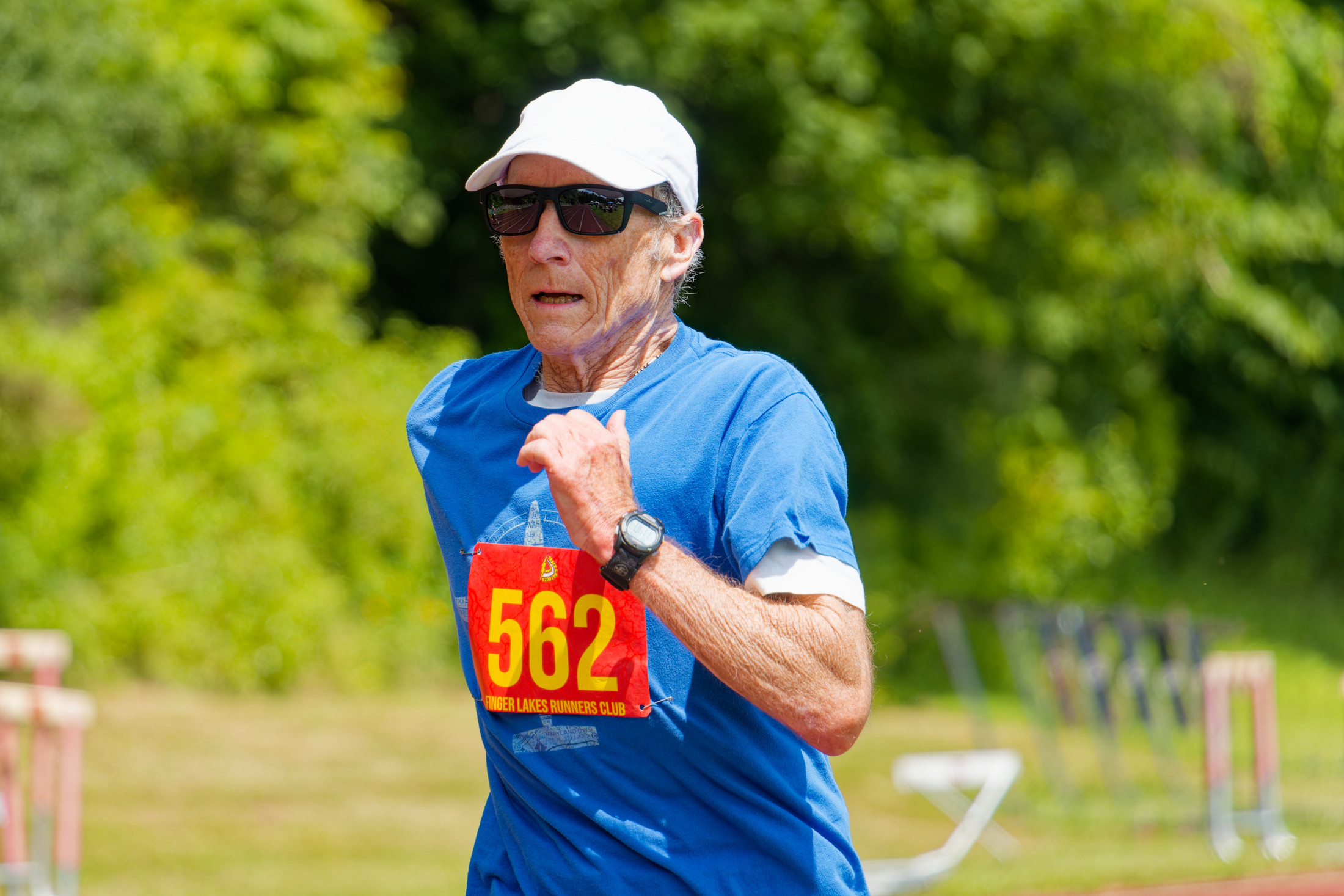
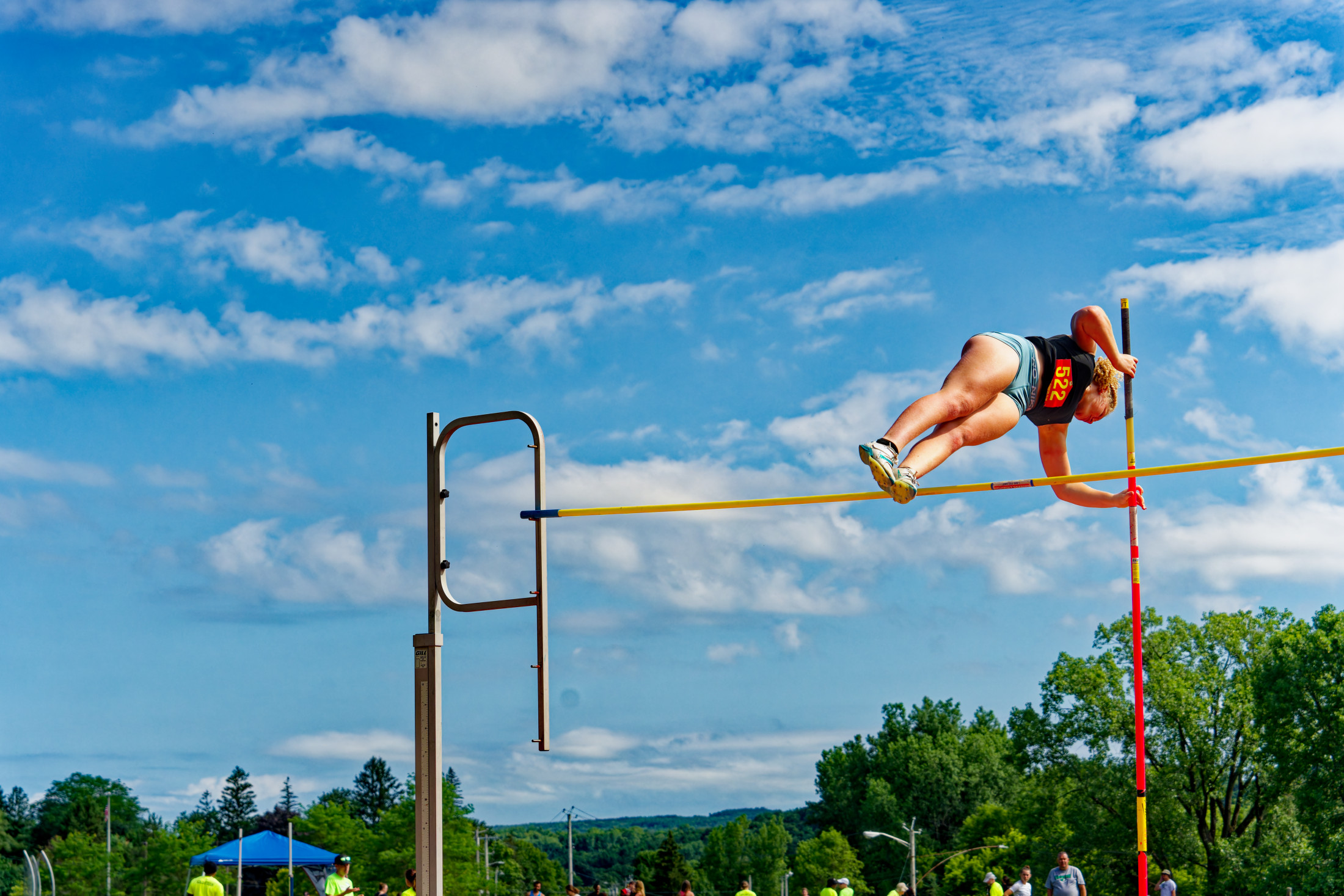
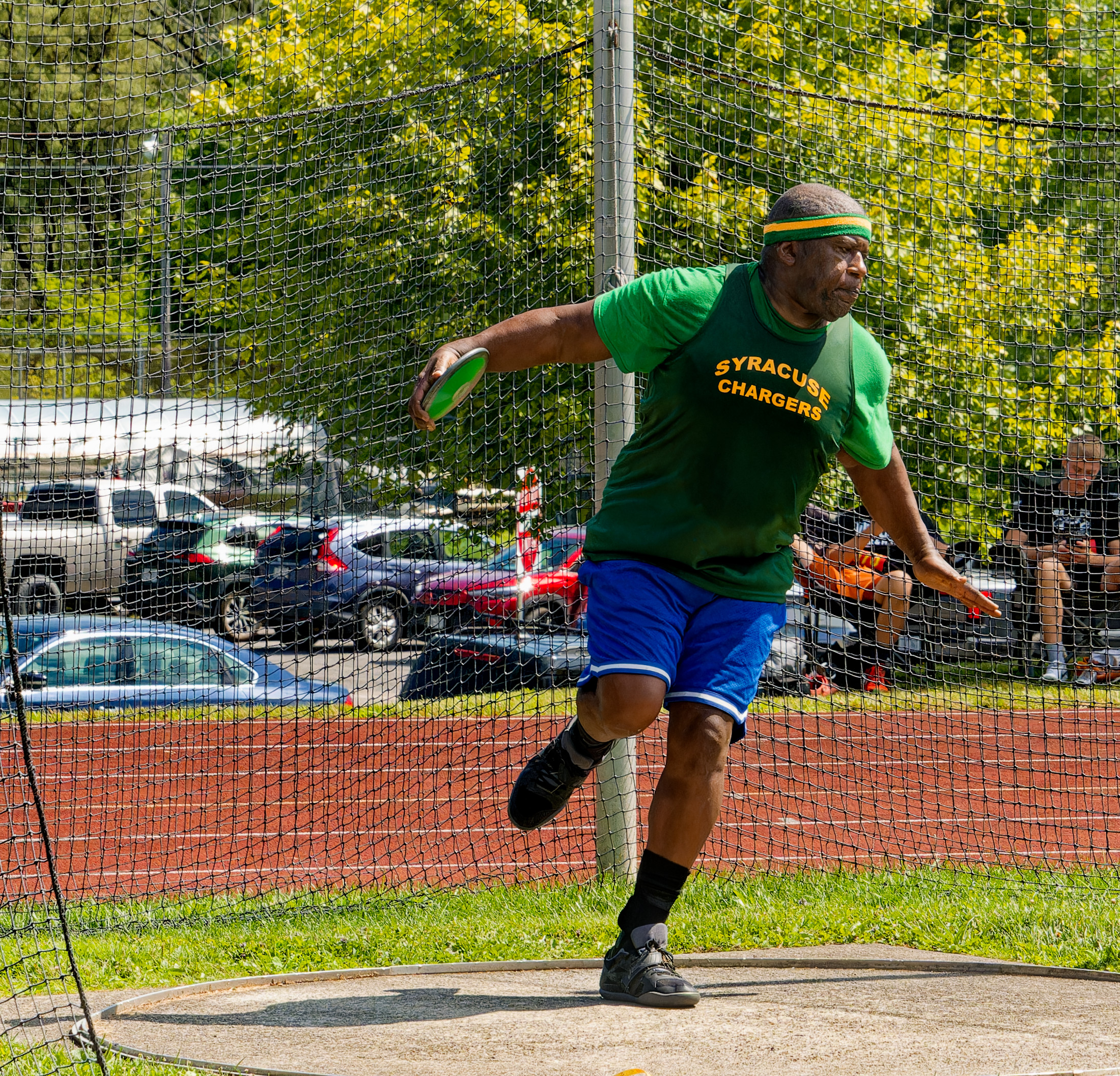
Our third and final indoor track meet of 2026 brought another strong crowd to Barton Hall. We hosted 238 athletes with 539 event participations from 15 teams, including the Binghamton University Running Club, Cornell Running Club, Cornell Track & Field Club, GIAC Navigators, Groton Project TC, Mustangs Track Club, North Penn-Mansfield, SOAR Running Club, Southern Cayuga, St. Francis St. Stephen, SVE Running Club, Syracuse Chargers, Syracuse Track Club, Troy Track & Field, and Trumansburg Track Club. Full results are available on the FLRC website along with numerous photos from Chris Petroff.

3000m

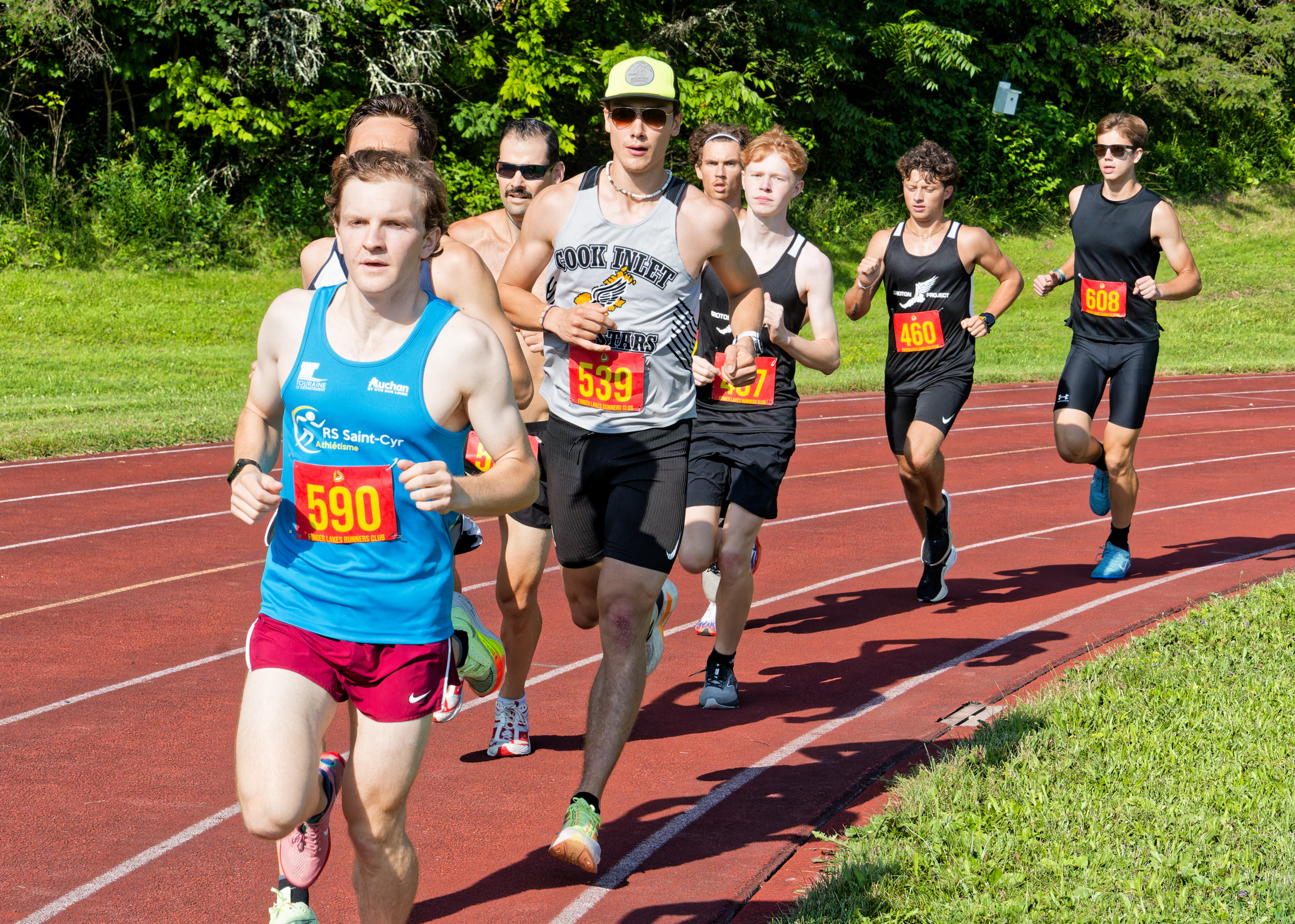
In the 3000m, Christopher Petroff and the Syracuse Track Club’s Dave Cook broke away from the pack with four or five laps to go but it was Cook who kicked hard from 300m out to claim victory in the 3000m with a 9:41.6, with Petroff following in 9:52.0. The Mustangs Track Club’s Donnell Davis rounded out the men’s podium in 9:56.1. For the women, Binghamton University RC’s Eva Curran competed in the fastest heat and took first in 11:05.3, with Laura Powers of the Mustangs Track Club claiming second in 12:44.5 and SVE Running Club’s Madelyn Ellison placing third in 14:13.4. Of special note, 13-year-old Alden Morseman ran an impressive 10:59.8 to finish tenth overall, while 68-year-old John Hummel completed the distance in 14:22.1.

60m

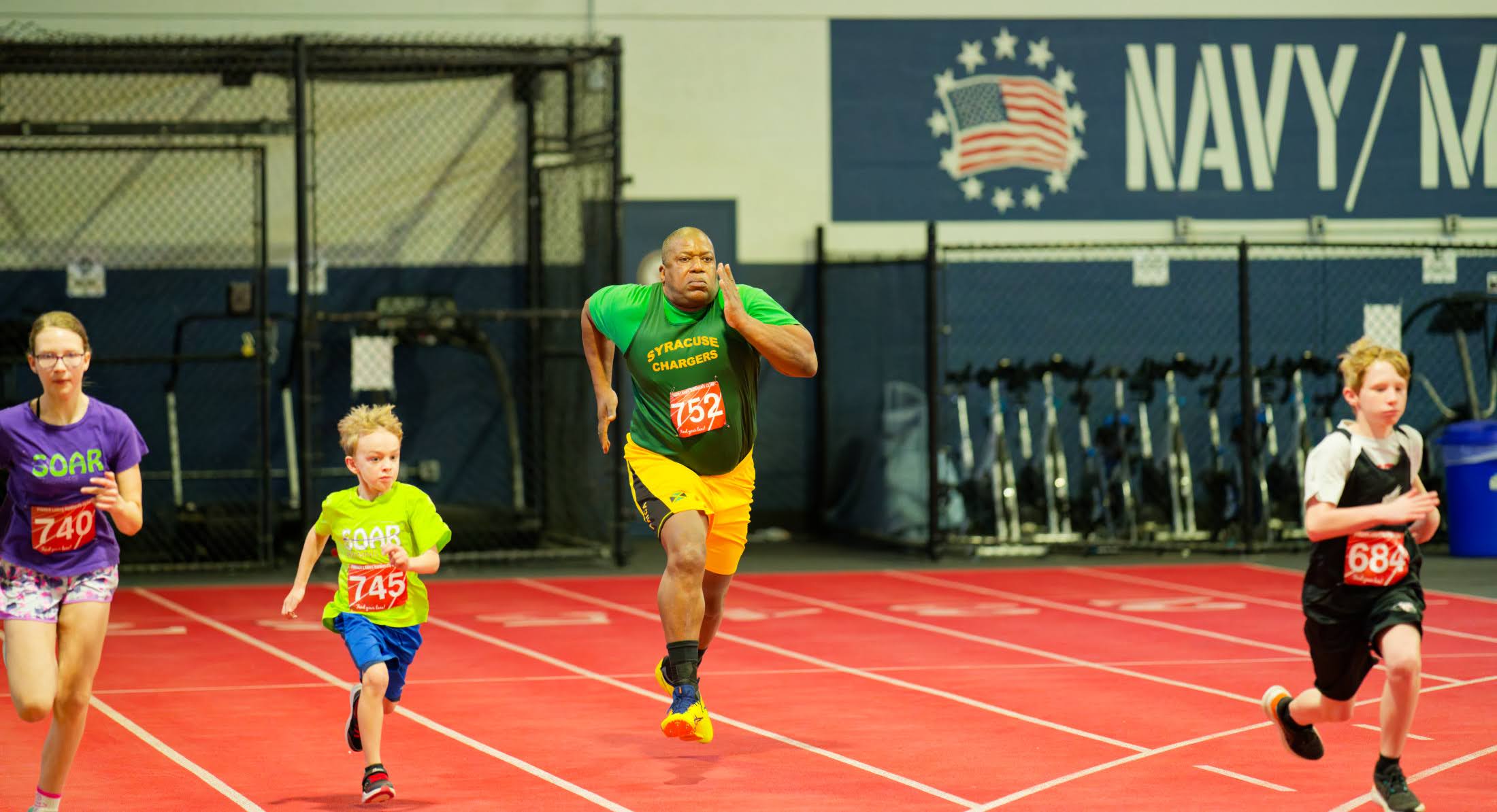
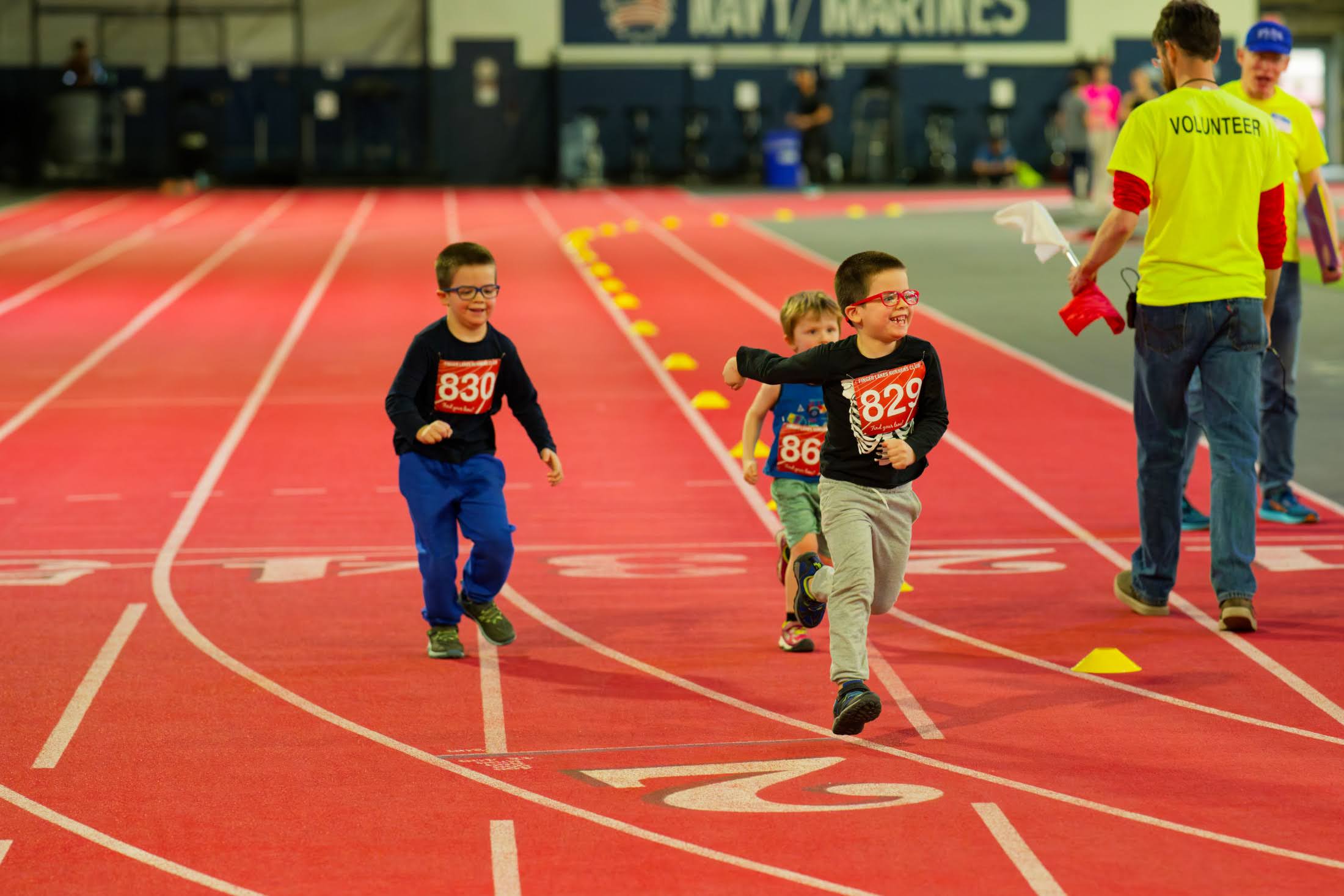
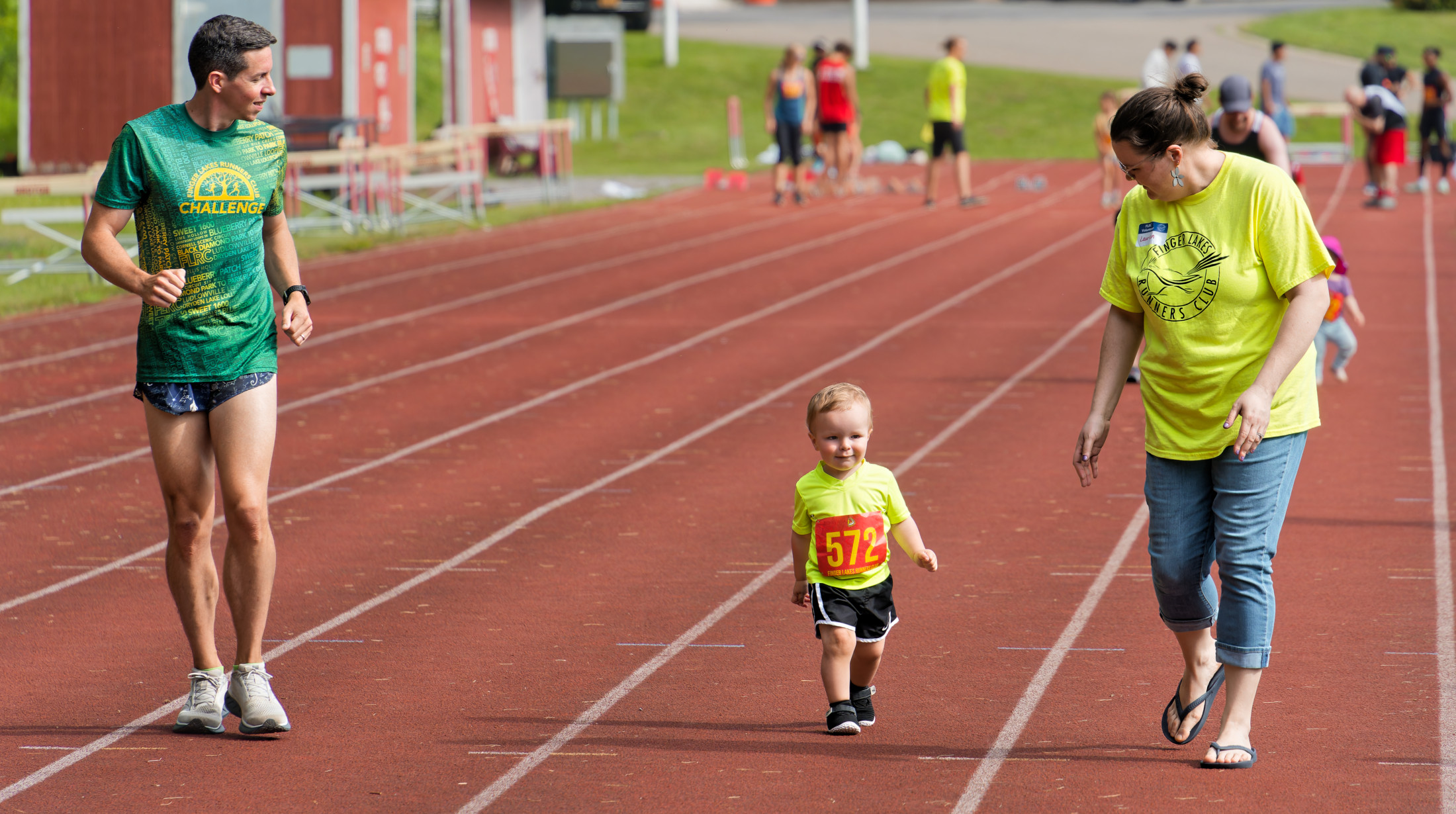
The 60m dash featured 107 finishers across numerous heats. The Cornell Track & Field Club’s Ryan Haisler sped to victory in 7.25 seconds, with Brayden Taylor taking second in 7.44 and the Mustangs Track Club’s Aaron Greaves securing third in 7.47. Among the women, 14-year-old Harper Lee of Troy Track & Field led the field in 8.88 seconds, followed directly by 16-year-old Charlotte Hulsey in 9.04 and 13-year-old Finley Hulsey in 9.56. The toddler heats were once again a crowd favorite, with 1-year-old Cordelia Gorges of the Groton Project delighting spectators with her 43-second 60m toddle. At the other end of the age spectrum, the Syracuse Chargers’ Karen Ellsworth completed the sprint in 11.83 seconds at age 63.

1 Mile

Our second most popular event with 103 finishers, the 1-mile saw a near photo finish at the front, with Lucas Baker edging out 40-year-old Bryan Morseman by just half a second, 4:35.2 to 4:35.7. The Groton Project’s Paul Hayden rounded out the podium in 4:40.8. For the women, the Mustangs Track Club’s Elizabeth Lucason led the way in 5:18.9, with Anne Riordan, 41, taking second in 5:24.5 and Hailey Whetten finishing third in 5:29.0. The race saw solid performances across the age spectrum: 14-year-old Logan Pearson recorded a strong 4:52.1 for 13th place overall, and 64-year-old Joe Mora turned in an impressive 5:24.8.

400m

In our spotlight 400m, with time-restricted entries, Alexander Simpson dominated the men’s race, cruising to victory in 51.95 seconds on legs tired from a third-place 4:17 finish in the Belmar Mile the day before. Binghamton University RC’s William Belardo secured second in 54.44, with the Groton Project’s Paul Hayden claiming third in 54.69 for his second podium finish of the day. The Cornell Track & Field Club swept the women’s podium, with Ashley Wong winning in 1:00.67, Mia Jarrell following in 1:01.32, and Lucia Gore taking third in 1:02.54. Notably, all three women’s times placed in the top 10 on the FLRC Track leaderboard, with Wong’s time slotting in at third all-time.

200m

The Mustangs Track Club’s Siyel Bowman flew to victory in the 200m with a 23.36 showing. The Cornell Track & Field Club’s Ryan Haisler—doubling back from his 60m win—grabbed second in 23.85, while Bowman’s Mustangs counterpart Aaron Greaves rounded out the top three in 24.67. The Cornell Track & Field Club dominated the women’s podium, with Ashley Wong crossing first in 27.33 seconds—a time that ties for ninth on the FLRC Track leaderboardMia Jarrell following in 27.40, and Troy Track & Field’s Harper Lee securing third in 29.29 for her second top-three sprint finish of the day. Our fastest single-digit runner was 8-year-old Zai’vyon Smith of the GIAC Navigators, who finished in 36.57, while 65-year-old Arthur Scissum ran an impressive 29.98, just 0.68 seconds off the fastest time on the leaderboard for the 60+ age group.

4x200m Relay

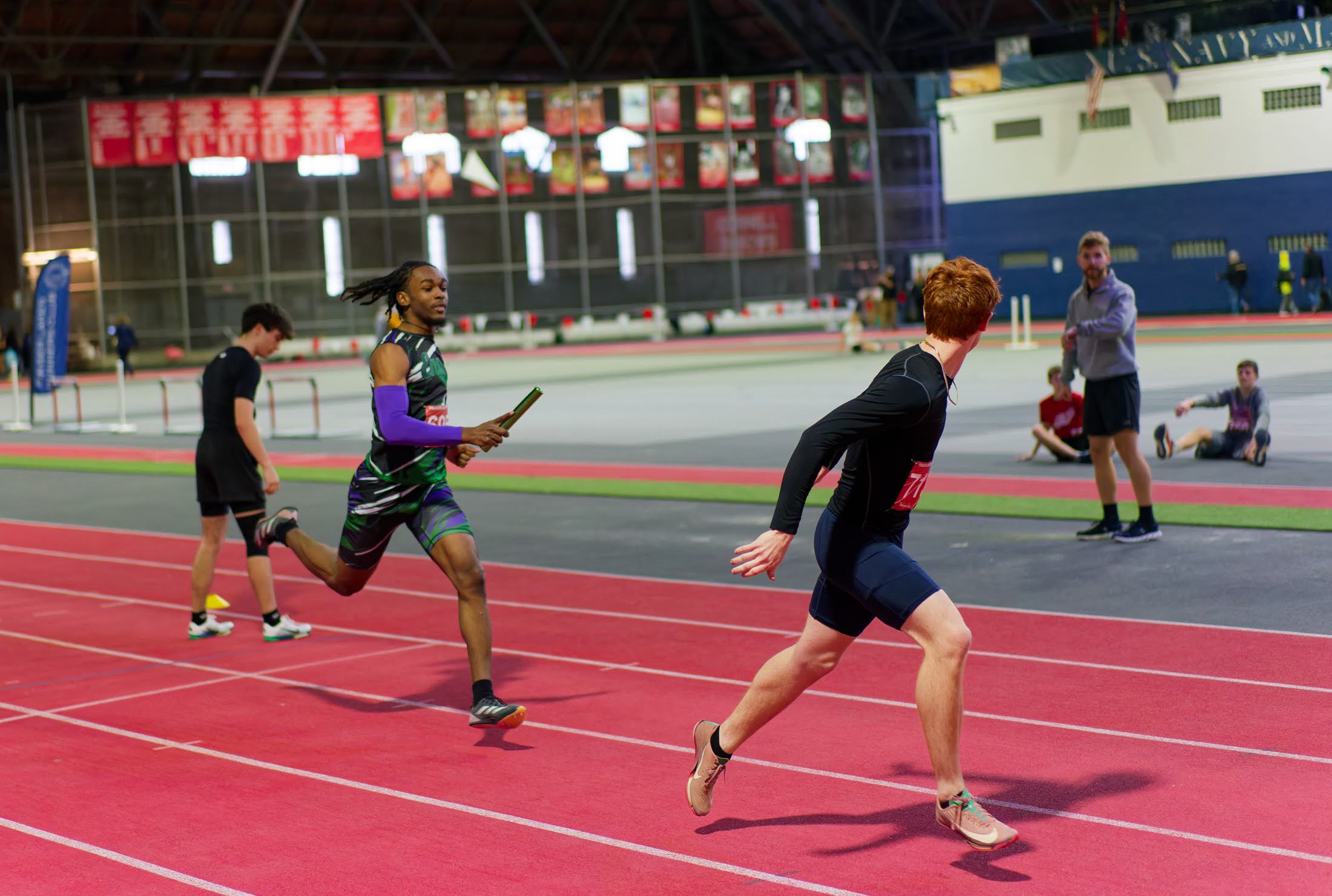
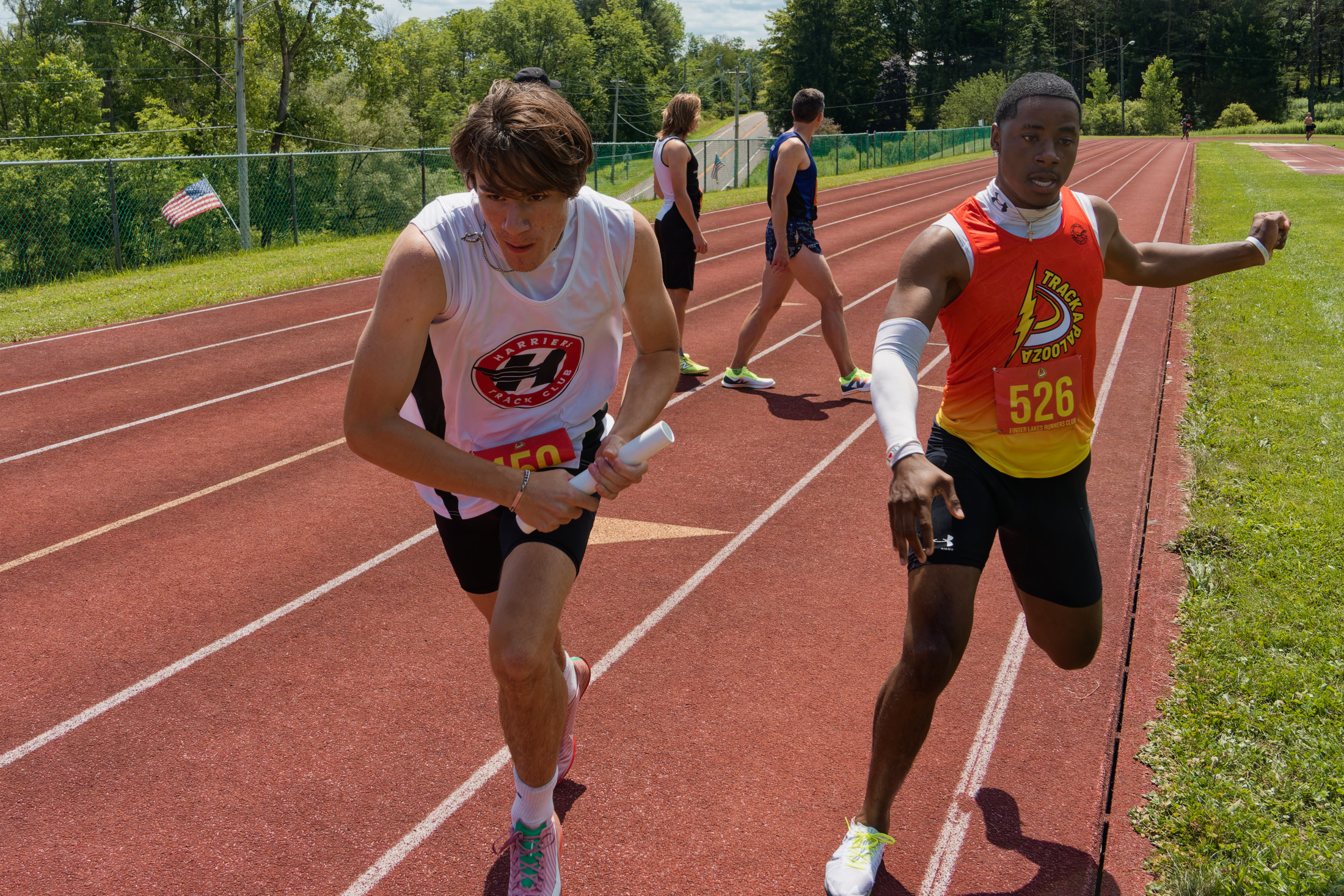
Binghamton University RC dominated the relay competition, taking first, second, and third with times of 1:48.7, 1:49.4, and 1:54.1, with the Tickled Pink team placing fourth at 1:56.5. All told, six teams broke the 2:00 barrier.

High Jump

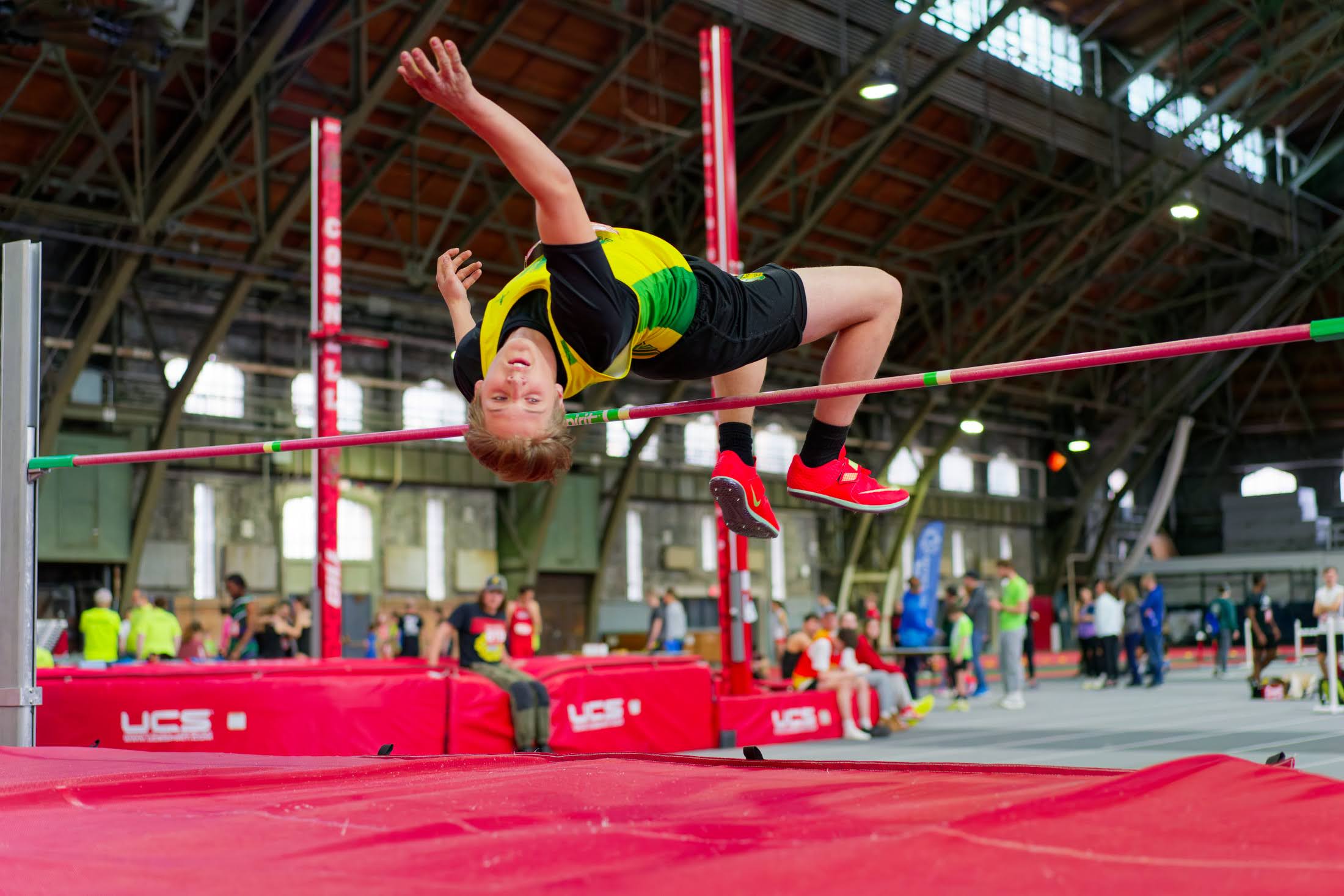
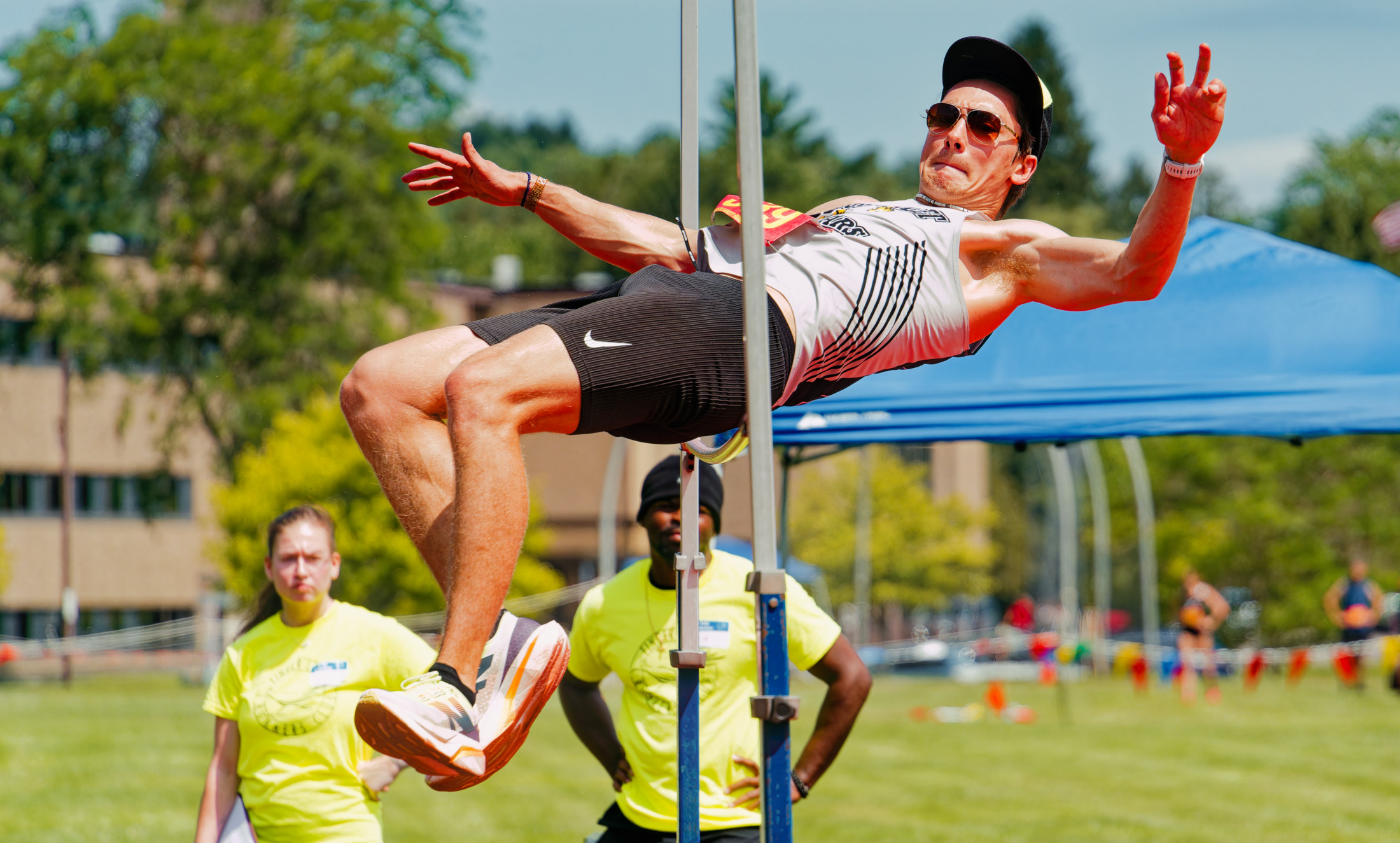
Brayden Taylor cleared 5 feet, 8 inches to claim victory in the high jump, notching his second top-three finish of the day after his runner-up showing in the 60m. The GIAC Navigators’ David Gamble reached 5 feet, 2 inches for second, while Jacob Czarnecki and Jarryd Witzel tied for third at 4 feet, 10 inches. Among the women, SVE Running Club’s Madelyn Ellison led with a clearance of 4 feet, 6 inches—a mark that ties for seventh on the FLRC Track leaderboard. Gretchen Hulsey took second at 4 feet, 4 inches, while North Penn-Mansfield’s Nora Furry and Kate Hulsey tied for third at 4 feet, 2 inches. The Syracuse Chargers’ Karen Ellsworth, 63, cleared 3 feet, 4 inches.

Long Jump

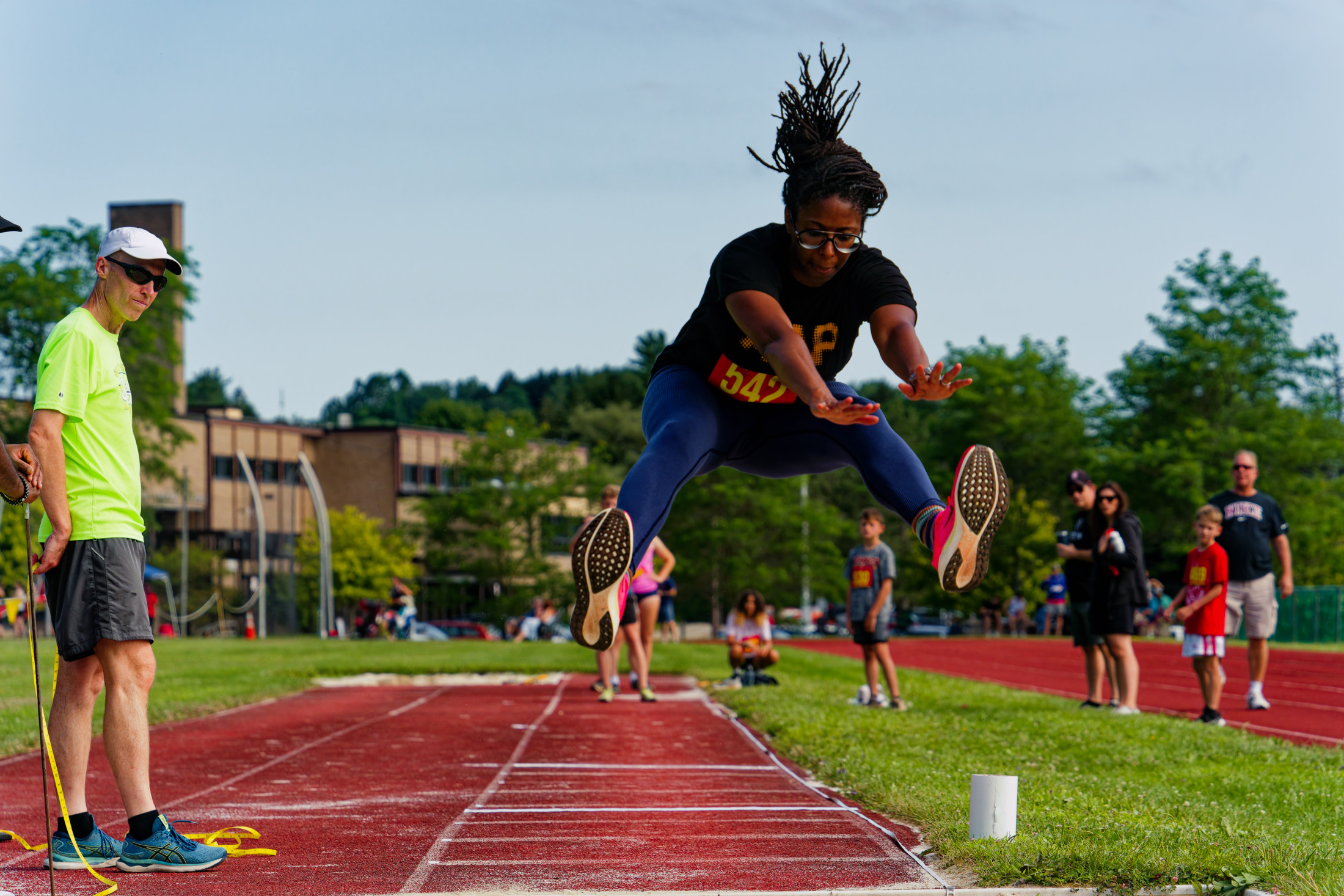
For the men, the Groton Project’s Suansian Songput soared to victory in the long jump with a mark of 19 feet, ¼ inch. SVE Running Club’s Landon Whitmarsh and North Penn-Mansfield’s Brayden Johnson tied for second at 18 feet, 4¾ inches. In the women’s competition, Troy Track & Field’s Harper Lee capped off a dominant day with a leap of 13 feet, 11½ inches for her third podium finish of the meet, along with the 60m and 200m. Keeping it in the family, the Groton Project’s Lungawm Songput claimed second at 13 feet, 1½ inches, while North Penn-Mansfield’s Carolyn Cherwinski took third at 12 feet, 10½ inches. Among our older athletes, 65-year-old Arthur Scissum jumped 14 feet, 11½ inches, and the Syracuse Chargers’ Karen Ellsworth, 63, leaped 9 feet, 7 inches.

Thanks to Our Volunteers

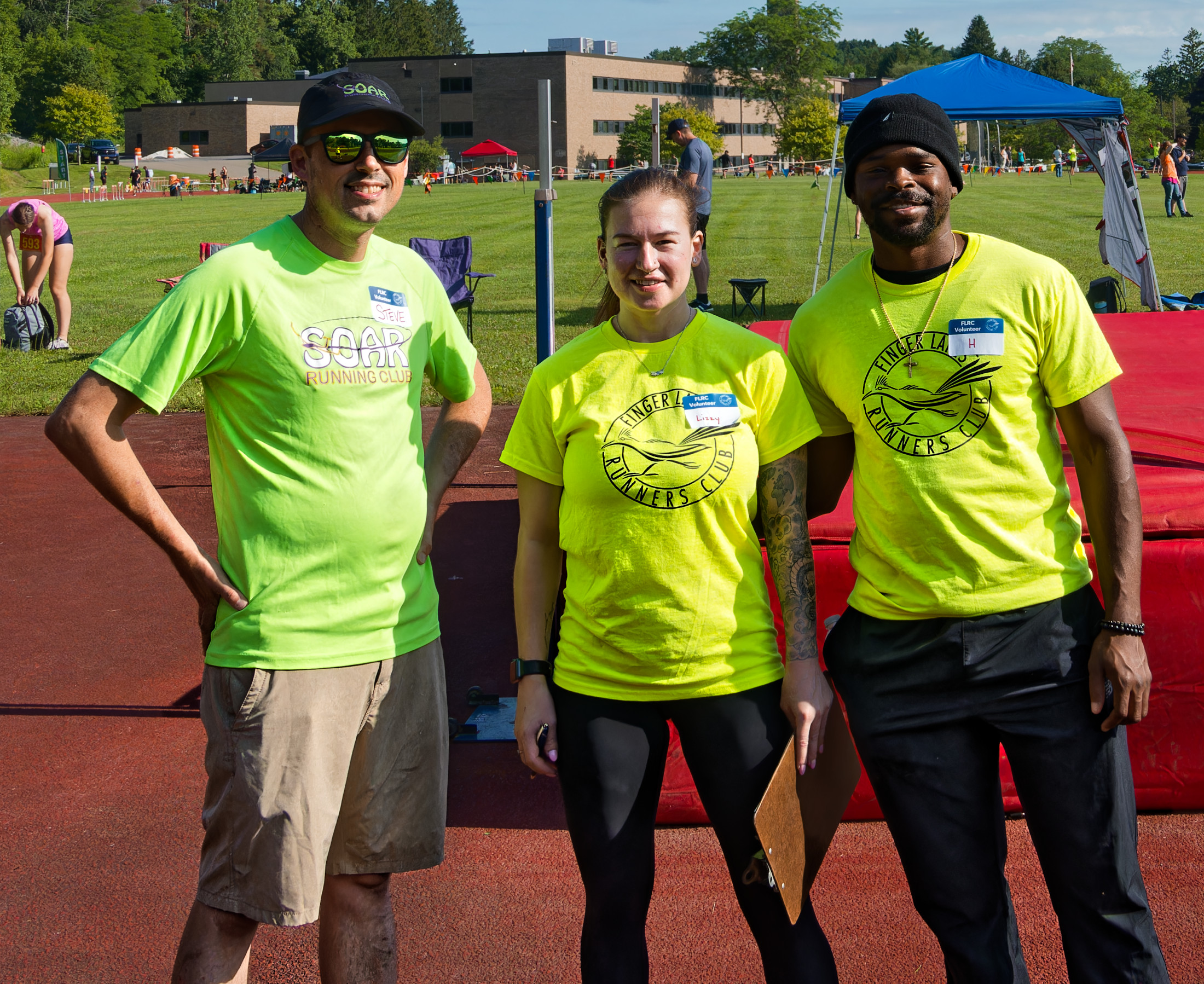
As always, FLRC track meets depend on the efforts of many dedicated volunteers. Katerina Tang arrived early to help with setup. Tonya Engst managed the registration desk with assistance from Charlie Fay. Patrick Boyle handled starting duties, while Molly Doruska served as head timer. Our timing team included Brian Belcher, Amy Dawson, Scott Dawson, Robert Swizdor, Bill Thibault, and Trent Thibault. Dave Kania and Jesse Koennecke kept reseeded heats and results flowing smoothly. Jon Lewis and Lizzy Rayle coordinated athletes as clerks of course, Chris Mellor recorded bib numbers, and Alec Timpe counted laps and ran the backup timer. In the field events, Brett Shelton coordinated the long jump with help from Leo Nakaranuruck, Marlene Kwee, and Seth Hallem, while Steve Wagner ran the high jump with assistance from Kacey Strang. Christopher Petroff took photos, and Diana Hackett and Heather Cobb handled FLRC clothing sales.

Thanks for a great indoor season! Our next track meets will be the outdoor Sunset Circuits and Trackapalooza meets this summer at Ithaca High School.
Super Frosty Loomis 2026 Raised the Bar on Super Frostiness

On February 7, 34 hardy racers challenged Mother Nature on a cold and windy Saturday, with a starting line temperature of -3 ºF. Due to the super frosty weather, everyone ran the 5K course so as to limit exposure, and we provided hand warmers to all runners. Everyone finished safe and sound, although there were some rather impressive beard and eyelash icicles. Despite the challenging conditions, some impressive times were put down (see results). Sebi Schonfeld won overall in 26:35, and Isla Chadsey led the women in 30:43. Check out the photos, too – we’ve uploaded some great shots from the event, and we’d love for you to add your own.

Many thanks to all our volunteers who made the race possible! Most notably, Martin Moravek and Eric Maki directed traffic, and Eric also supplied the snowshoe-fitting tent and helped with course cleanup. Tonya Engst managed bib pickups. Adam Engst handed out rental snowshoes, helped put them on correctly, and timed the race. Joel Cisne and Wilderness Search & Rescue watched over the racers on the course to make sure everyone made it back to the finish line. Diana Hackett and Eric Sambolec kept the Hill-ton warm and managed the snacks and hot beverages. Sarah Ridenour helped with course signage and awards. Finally, Gretchen Gilbert, Aaron Snow, Jon Lewis, and Ben Dickensheets swept the course and picked up flags. Special thanks to Charlie and Ann Leonard for the use of their driveway and their land where the start/finish are located, as well as the Hammond Hill-ton warming hut, and to Rob Kashik and Dion Snowshoes for the rental snowshoes.

— Dave Kania and Eric Sambolec, Race Directors

2025 Runner Survey Results and Responses

As part of our election for new FLRC board members, we asked some survey questions to help us improve our operations and give you a chance to share feedback on how the club is working. The survey garnered 92 responses. Thanks to everyone who participated! Note that, since this was an entirely self-selected survey, it reflects only the opinions of those who chose to participate.

Communications

We asked several questions about how you find out about FLRC events, how you view our race announcement volume, and whether you like race recaps. 

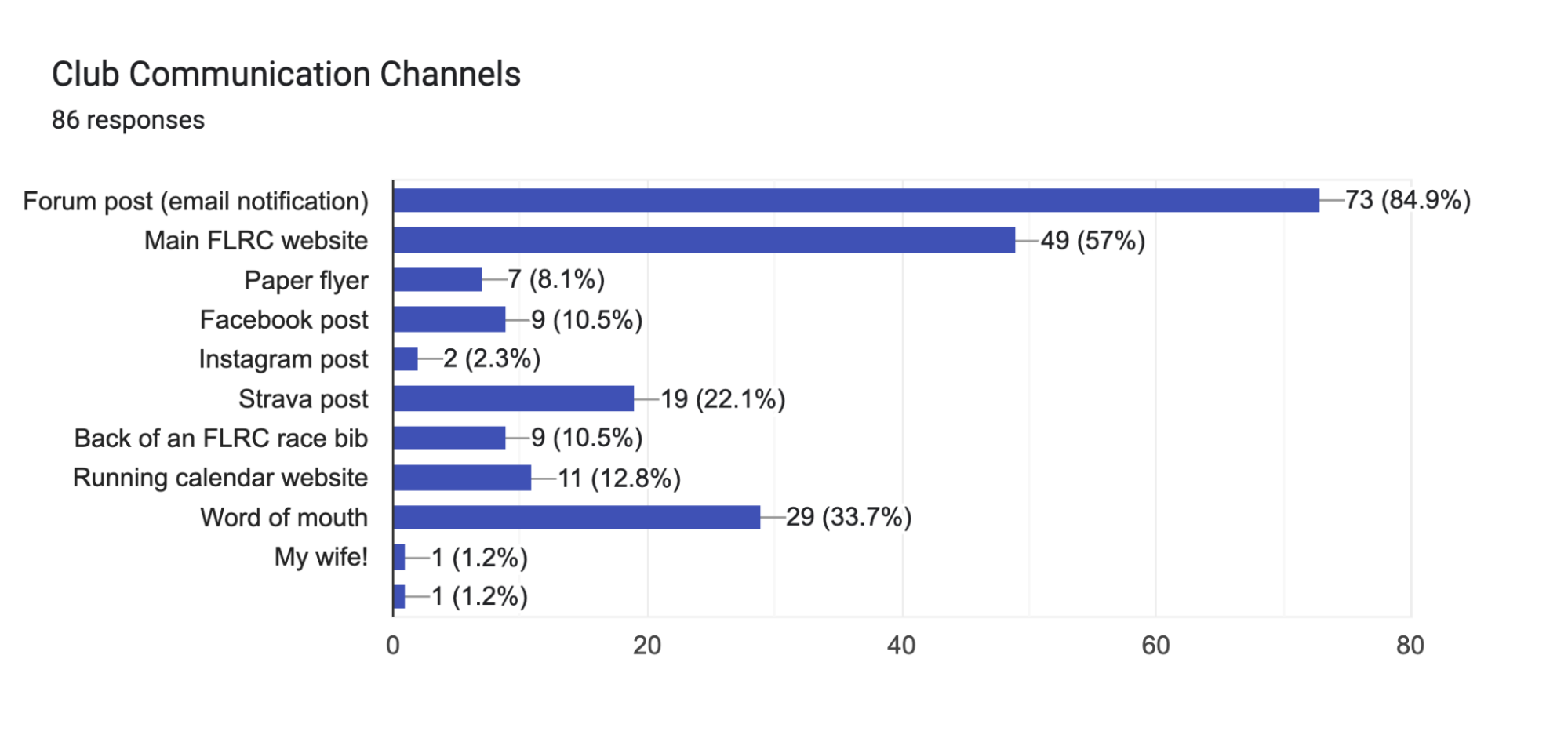
Most people learn about FLRC events through the FLRC Forum and the club website, with word of mouth as the third most common method. After that, Strava posts, running calendar sites, the back of FLRC race bibs, Facebook, paper flyers, and Instagram (in that order) all played smaller roles. They’re still valuable, though, especially when it comes to reaching people who don’t already know about the forum or club website.

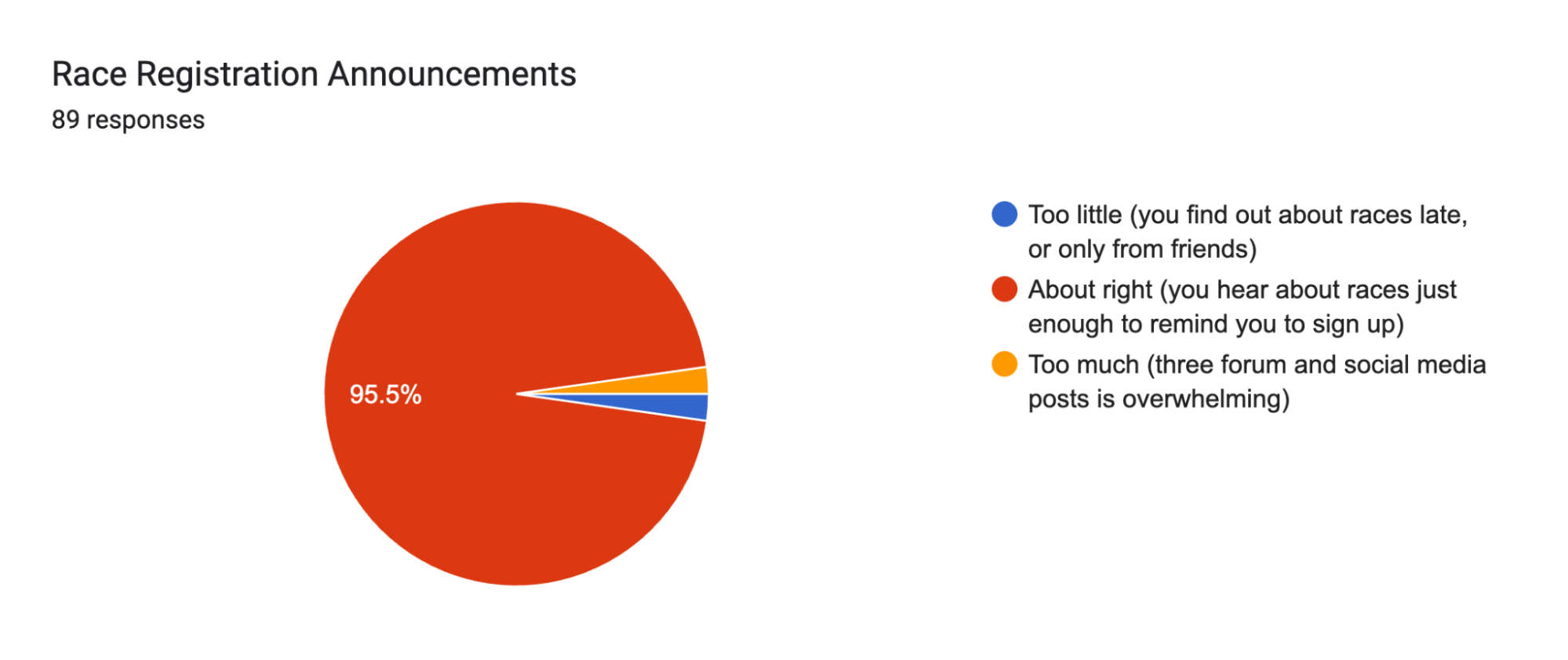
Nearly everyone felt the number of race announcements was just right, with two people saying it was too many and two saying it was too few, so we’ll stick with our current approach. 

Race recaps were also quite popular: 78% of respondents said they liked them, and only 22% said they seldom read them—no one actively disliked them. The freeform responses suggested that people liked how they fostered a sense of community, recognized volunteers, and called out both fast times and unusual achievements (such as the youngest/oldest finishers) or happenings. Photos were appreciated—and remember, there are thousands of great photos in our photo library!—and people like how we try to bold everyone’s name in writeups. Because yes, it is all about you!

Clothing

We asked questions about clothing: one about the blanks (premium brands versus more affordable bulk brands) and another about whole-shirt designs versus simple front/back silk-screen prints.

Regarding brands, responses were mixed. About 35% of respondents prefer the premium brands, even if that means higher prices (such as with the Trail Circuit shirts), while 8% prefer the more affordable bulk brands (such as with the new FLRC Rebus T-shirts); another 35% think it depends on the item, and 22% have no preference. To my mind, that says that we should keep mixing it up. 

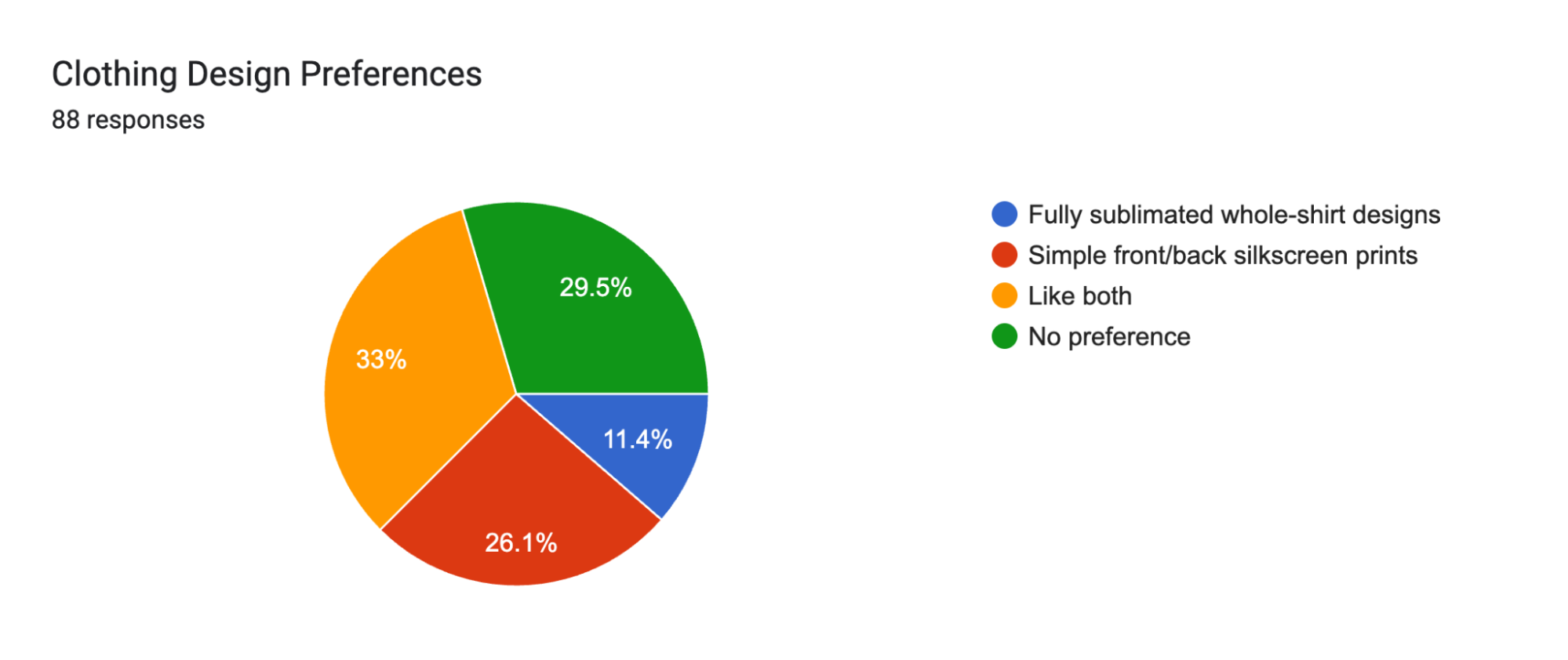
Similarly, the responses regarding Clothing Design Preferences are entirely mixed. The simple front/back silkscreen prints (such as the FLRC Rebus shirts, the Turkey Trot sweatshirt, and the Ithaca 5&10 shirts) garnered 26% of the votes, where the fully sublimated designs (Challenge shirts, Skunk Cabbage shirts) garnered 11%, but 33% of people like both, and 30% have no preference. For the 2027 Skunk Cabbage, I’ll probably do a simple design on cotton.

The other thing that came up in the freeform comments is that many people would like more cotton shirts. That’s partly why we made the FLRC Rebus shirt in a soft cotton blend, and the Ithaca 5&10 shirts the last two years have been cotton. A few people also encouraged us to look into environmentally sustainable fabrics—we do keep that in mind whenever possible, but it can significantly increase prices, so it’s a fine line to walk.

There were also several requests for more variety, especially with tank tops (the 2025 FLRC Challenge women’s racerbacks were extremely popular) and long-sleeved shirts, as well as hoodies, beanies, quarter-zips, and sweatpants. We hear you, but keep in mind that designing, ordering, and selling merchandise requires a lot of effort, so there’s a limit to how much we can do each year.

There were a few misapprehensions that I wanted to clear up, too:

  • There was a note that not every race needs its own shirt, and that’s absolutely correct. In fact, most of our races don’t have shirts, with those that draw a lot of out-of-towners being the main exceptions (Skunk Cabbage, Finger Lakes 50s, Ithaca 5&10, Turkey Trot, and the Hartshorne Masters Mile). And, except for Finger Lakes 50s and Hartshorne for historical reasons, all other race shirts are optional purchases, so we’re certain people are only getting shirts they want to wear.
  • Several people asked for running hats, presumably because they haven’t seen that we have a new Boco hat. It’s a fresh design to shake things up from the standard club logo, which many people already have from the last order. (Please excuse the graphics on our online store—you can see items in person when we’re selling clothing at track meets and races. If you have graphic design skills and would like to help improve those images, let me know.)

Running-Related Classes and Clinics

We asked what sort of classes or clinics on running-related topics you might be interested in attending, and we got lots of great responses: 

  • Strength Training & Injury Prevention: Strength training was the most frequently requested topic, often paired with injury prevention, mobility exercises, and stretching.
  • Nutrition and Fueling: Several respondents requested clinics focused on nutrition and diet, including proper hydration and fueling for optimal performance and recovery.
  • Training Plans and Techniques: Requested classes included building a training plan, how best to incorporate speedwork, following a training plan when life gets in the way, and techniques for trail racing.
  • Mental and Race Preparation: Other interests centered on dealing with race-related anxiety, mental toughness techniques for racing, and general race preparation, along with a request for a marathon training class/support group.
  • Other Specific Ideas: Additional suggestions included running form analysis, Q&A sessions with competitive runners, a virtual fascia workshop, guidance on interpreting running metrics, and advice on preventing chafing in ultras.

Last year, club volunteers led workshops on strength training, fascia release, balance, and mindfulness. Frankly, the only limitation here is finding someone who wants to make a particular class or session happen and is willing to share their knowledge or recruit a speaker. The club’s Comm Team can help promote the event, and various club members have donated their space in the past. Get in touch if you want to make a class happen!

Race Satisfaction

The survey asked a variety of questions about your satisfaction with our races, and I’m pleased to say that 97% of all the responses were Satisfied or (more likely) Very Satisfied. Multiple respondents praised the organization and quality of the races, describing them as “incredible,” “fantastic,” “extremely well-run,” and “smooth.” Thank you for the kind words, and thanks to our race directors for their efforts in making this happen!

There is always room for improvement, though, and several people commented that they would like to see more gluten-free options and fewer highly processed foods like commercial nut butters and cream cheeses. Our Food Team is aware of the desire for gluten-free options and provides them at many races, so if you don’t see them, ask a volunteer. I’ve made sure to communicate the desire for less processed foods to the Food Team and race directors.

I’ve also communicated to race directors a comment about not having dogs at water stations. Just as dogs in races may be problematic because they can behave unpredictably and their presence makes some people anxious, the same is true in other aspects of races.

A few things to clear up:

  • One person asked for more Saturday races instead of so many Sundays. There are slightly more races on Sundays (12) than Saturdays (10), but it’s pretty even. (There are also 2 Tuesday races and 2 Thursday races.) We try hard to include both weekend days, but some races have logistical requirements that prevent changing. 
  • There were several comments about high race entry fees. FLRC race entry fees are significantly lower than industry averages—most of our small community trail and road races cost just $20 with a $5 club member discount. A few of our races have higher entry fees because they cost a lot more to put on, such as Finger Lakes 50s, Skunk Cabbage, Monster Marathon, and Parallel of Latitude. Plus, we give free entry to runners 18 and under in all our road and trail races, and provide a no-questions-asked free entry coupon code to anyone who would not otherwise be able to afford the race (except for the Finger Lakes 50s, which has a cap on entries). In 2025, 7.5% of registrants used the free coupon. 
  • There was also some confusion about the FLRC Challenge, with someone thinking buying a shirt was required. It’s not—the shirts are optional—and although the Challenge is more expensive, that’s in part because it costs a lot to put on. Nonetheless, the free entry coupon is available for it as well.

There were also a few suggestions:

  • One person suggested we have a shorter endurance race, like the Southern Tier Running Club’s 3-hour 1.1-mile loop, with a supply table at the start. So, like our Parallel of Latitude race, but even more compressed. Our race schedule is already full with 26 races, and I can’t say that it will happen, but if someone wants to organize it…
  • Another suggested that we bring back the handmade mugs for prizes at the Twilight. I’ll communicate that to the race director. Locally hand-crafted items are lovely, and although they tend to be pricey, we like it when our race spending supports local artisans. The hard part is finding an artisan and coordinating the project.

Coming up with good prizes that winners will appreciate is harder than it might seem. Many types of prizes, such as medals or pint glasses, are no longer special to those who already have a collection, and other types, such as custom shirts or trophies, can be expensive or hard to organize in small quantities. Consumable prizes seem like a good idea, but giving out six-packs of beer and soda hasn’t worked as well lately, as people avoid alcohol and sugary drinks. (For age-group awards, the five-race PGXC series gives out a selection of boxes of Trader Joe’s chocolates, which are popular.) 

Workout Satisfaction

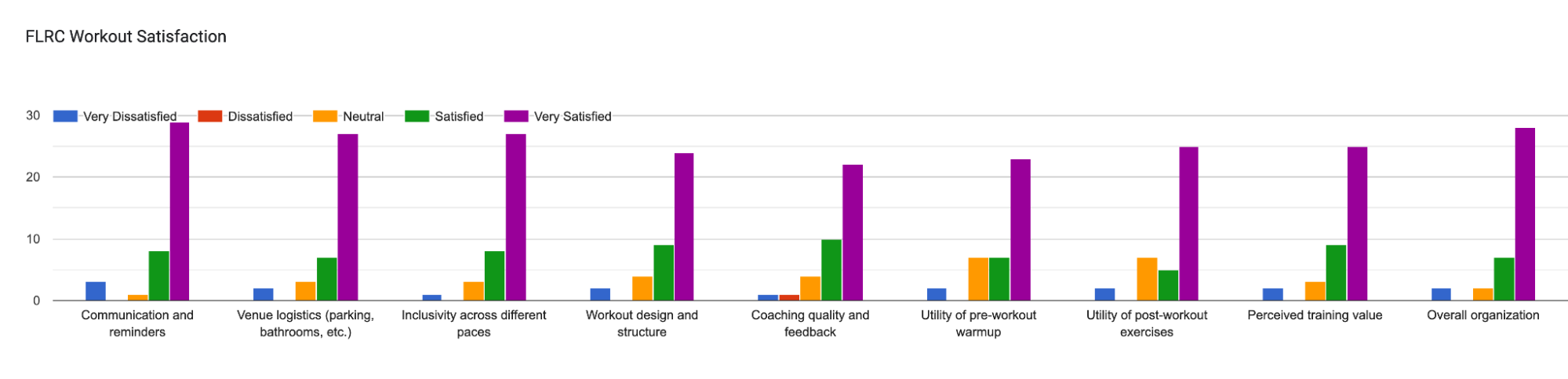
The survey also asked a variety of questions about workout satisfaction, which I’m going to take personally. (In a good way!) 90% of the responses were either Satisfied or, again (much more commonly), Very Satisfied. 

The main comments explaining the Neutral ratings and one Dissatisfied vote primarily revolved around:

  • Several people expressed a desire to start track workouts earlier, but that simply isn’t possible given the Cornell track team’s schedule. Sorry!
  • There were a couple of comments about how I tend to focus coaching advice on the faster runners rather than mid-pack runners. It may seem that way, but what’s actually happening is that I primarily direct such advice to people who have requested it. If anyone wants more coaching about pacing, form, injuries, or anything else, let me know at a workout.
  • A few people expressed a desire for workouts that focused on longer distances. That’s a tough problem because the pace variations among our regulars are so great (from sub-5:00 to 9:00). It’s easy to keep everyone feeling as though they’re in the same workout on the track, and in the Summer Speed and Cross Country workouts, I try to create intervals that keep the group roughly together. Otherwise, the group would instantly spread out, leaving most people to run on their own. That said, if you ask me, we can talk about adding a tempo workout on your own.
  • The number of people at the indoor track workouts was mentioned. We’re averaging over 70 people per night, most of whom are on the track (I also count kids and coaches). As long as we adhere to our track rules, it seems to be working out, but we can’t grow much more. Remember that Ian also coaches Monday and Wednesday track workouts in Barton for a few more weeks.

Group Run Satisfaction

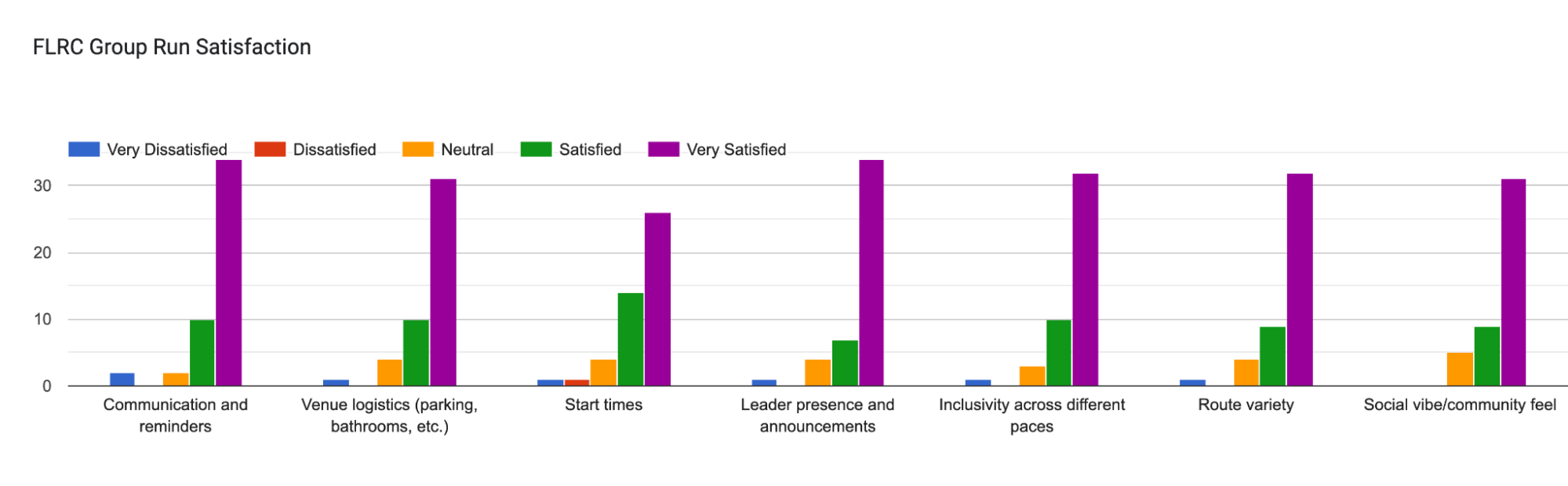
The final group of satisfaction questions revolved around group runs. 92% of the responses were in that Satisfied or (as usual, much more common) Very Satisfied category. 

Comments included:

  • One person said it would be nice to know there would be someone at their pace. That’s why we usually have the pace polls in the group run announcements. Unfortunately, people sometimes don’t want to vote because it makes them feel more committed than they want to be (or just because they don’t bother). All I can say is, please fill out those pace polls! We’ll try to encourage everyone to do so in person as well.
  • Another person commented that group runs were more fun with more people. We agree, and the pace polls can help show when it will be better attended. But you can help too. If you have a friend or two with whom you run, invite them directly so you know you’ll have someone to run with. We recruit shamelessly, and so should you. 🙂
  • There was some annoyance with assumptions surrounding where group runs were being held. We almost always try to include Google Maps links to the location for those who may not be familiar with the Cornell campus or local landmarks. If that doesn’t happen in a group run announcement, just ask for a link in a comment.
  • Some people asked for earlier or later start times. We’ve played with this, and we just can’t please all the people all the time. If you want to run earlier, consider running the course so you finish as the main group starts. If you want to run later, consider starting when the main group finishes. That way, you get to socialize and feel like a member of the community while still hitting your preferred time. Or just post your own group runs at your preferred time!
  • Speaking of which, someone else asked if it was OK to post their own group runs. Absolutely! The Group Runs & Workouts category on the forum is open to everyone, so just post with when you’re running (day and time), where you’ll be starting, how far you’ll be going, and what your rough pace will be. You could even arrange to finish at a brunch spot!
  • One person suggested we form special-interest groups, such as those training for marathons. That’s a great idea—talk with group run coordinator Heather Cobb about how you can help organize such runs. (See what I did there? Things happen when people volunteer. 🙂)

Anything else you want to share about FLRC?

Rather than try to summarize these responses, I’ll let them speak for themselves. Thank you for all the kind words, and thanks to everyone who makes the club deserving of them!

  • Thank you for doing a phenomenal job!!
  • Really like the summer Challenge!
  • Great work!! The club is great.
  • You all do such a great job. There is an amazing variety of running challenges and races. It has made me do different types of runs/races that have pushed me out of my comfort zone in amazing ways (I’m looking at you, Super Frosty Loomis!)
  • The food at the end of the races is always fantastic. It’s great that you keep prices at a reasonable level and that you make many races free for the under-18 crowd. It has encouraged my young teen to do some races he probably wouldn’t have considered if he had to pay the full fee.
  • Thank you for all your hard work again this year. You are all greatly appreciated!
  • FLRC is great. I love being involved with the kids’ activities. I have not been running much, so my participation is low, but as a former Ithaca runner, I am very impressed and happy to be a part of it on occasion.
  • This organization, its board of directors, and its volunteers are all amazing. Our community is very fortunate to have the FLRC. Thank you!!!!
  • Best running club around IMHO. I like how inclusive it is for all runners (not just the elite speeders). Keep up the great work. I try to do my share with some event volunteering during the year.
  • FLRC is such an amazing community. I deeply appreciate the work that Adam and so many other volunteers put in. I’ve made so many friends through FLRC and always feel welcome and supported. Volunteers go above and beyond to make race experiences five star! I love how the club is always open to feedback and looking to improve.
  • Thank you for all you are doing for the community!
  • We love FLRC! We finally feel like part of the community here in Ithaca.
  • Great club
  • So grateful for you! I’d love to have even more trail races! One day, I hope I can help promote a race, but I am swamped right now.
  • I deeply appreciate all the efforts that the board, race directors, and event volunteers put into this wonderful club. Special thanks above all to Adam and Tonya!
  • I really appreciate how community-focused and affordable FLRC is. Great combination of races and events with entry prices that are much more affordable than other running groups.
  • Thanks!
  • Love you all!!
  • Thank you!
  • I have greatly enjoyed the Thursday Young at Heart Group Runs organized by Kate and Jon, so huge props to them!
  • Very impressed with how large this group is and how many events/runs/gatherings take place. Just wish I could retire early and take part in more of them!
  • Very happy
  • Thank you for all you do!! We have such an amazing community.
  • An impressive effort by all who volunteer to make the club and its events so awesome! Thank you! Wish I lived closer, but I still get there often enough for events, a few group runs, and a volunteer gig or two. Who comes up with those clever Skunk Cabbage Classic themes every year? Love ’em! Love the FLRC Challenge – it gets better every year!
  • Keep on the same line. The Challenge is good to get the signs out into the neighbourhoods so more non-FLRC people will see them and (we hope) be curious.
  • As always, my appreciation goes out to all the members who work so hard behind the scenes to keep this club functioning. A big hearty thank you!!!!
  • I really appreciate the work that the club does to involve people in running from beginners to experts. There are so many different kinds of opportunities that enable anyone to get involved. I also appreciate all the communication around club events and opportunities. Thanks so much for your hard work!
  • Thank you so much for being such a great running club. It’s a lot of work, and I appreciate it!
  • I wouldn’t change much of anything. It is a great organization and community. Wish I lived closer to be able to enjoy and contribute more.
  • FLRC is great!
  • Increased group runs have made the club more welcoming!
  • I’m fairly new, and feel like I need to have more experience before commenting on a lot of questions. Thank you for what you do.
  • I’m very happy with the way this club upholds both a competitive environment in its events and a welcoming environment for its first timers. It also appears to me as an outsider looking in that you aren’t afraid to try something new, reflect, and adjust. I’ve got nothing but good things to say about this group.
  • I really appreciate the wide variety of races, group runs, and non-race events that FLRC puts on year after year!
  • Grateful for the club
  • I love the FLRC! There is literally something for everyone – easy weekend runs, trail & road races at various distances, weekly workouts, and truly great people! And, of course, none of this would be possible without the excellent leadership of Adam and Tonya. Thank you so much – you are genuinely appreciated!
  • Thanks to all volunteers! The positive impact FLRC has had on both my physical and mental health cannot be overstated.
  • I feel privileged to be part of such an active and well-managed running club. So many volunteers give so generously of their time and talents.
  • Great organization – happy to be a member and occasional helper!


Two new FLRC Track leaderboard bests at the February Flash Dash

Our second indoor track meet of 2026 drew an enthusiastic crowd to Barton Hall. We hosted 218 athletes with 503 event participations from 15 teams, including the Candor Running Club, Cornell Running Club, Cornell Track & Field Club, GIAC Navigators, Groton Project TC, Montrose High School, North Penn-Mansfield, Odessa-Montour, SOAR Running Club, St. Francis St. Stephen, SVE Running Club, Syracuse Track Club, Troy Track & Field, Trumansburg Track Club, and the Wyoming Elite Track Club.

Among many strong performances, three athletes claimed new top-three spots on the FLRC Track leaderboard: 50-year-old Sascha Scott in the 800m, Tessa Love in the high jump, and Maximus Kuwaye in the long jump. Full results are available on the FLRC website, and our roving photographers captured a bunch of group shots.

1 Mile

The 1-mile saw a strong masters performance at the front, with 40-year-old Bryan Morseman taking the lead after the first few laps and extending it throughout to win in 4:43. The Syracuse Track Club’s William Hoyne, 43, closed hard to place second in 4:46, and Tony Dirubbo Jr. rounded out the podium in 4:48. For the women, 41-year-old Anne Riordan led the way in 5:30, with Liz Hartman, 43, taking second in 5:43 and 17-year-old Kate Hulsey crossing third in 5:53. The race saw solid performances across the age spectrum: 13-year-old Alden Morseman ran a strong 5:30 to match Riordan’s time, and 73-year-old Ken Hodges managed once again to break 7:00 in his 70s, running an impressive 6:55.

60m

The 60m dash featured 103 finishers across numerous heats. Logan Aman of the Candor Running Club (who holds third place on the FLRC Track leaderboard with a 6.58) scorched the track in 6.94 seconds for the win, with Ryan Haisler claiming second in 7.13 and Montrose High School’s Maximus Kuwaye securing third in 7.19. Among the women, it was an extremely tight race; 13-year-old Anaite Gonzalez took top honors in 8.67 seconds, followed by 14-year-old Harper Lee of Troy Track & Field in 8.85 and the Groton Project’s Karson Mackey in 8.87. The toddler heats were once again a highlight, with 2-year-old Miles Zalasky completing his 60m toddle in 29.67 seconds, and 1-year-old Cordelia Gorges of the Groton Project following in 39.03. At the other end of the age spectrum, 67-year-old Timothy Christian ran 10.41 seconds, and 70-year-old Paul Ohama crossed in 11.18.

800m

Alexander Simpson dominated the 800m, cruising to victory in 1:56 with a comfortable margin over second-place Aloysha Lynd, who ran with Simpson for a strong first two laps before finishing in 2:04. Although Simpson’s time would have ranked second on the FLRC Track leaderboard, he is already tied for the top spot with last year’s 1:55. Masters runners claimed the next spots, with Bryan Morseman, 40, coming back from his win in the mile to tie for third (by time, they were in different heats) in 2:09 with the Groton Project’s Scott Weeks, 54. On the women’s side, the Syracuse Track Club’s Sascha Scott, 50, ran a blazing 2:20 to win—a time that puts her in first place on the FLRC Track leaderboard and is only about 1 second slower than the women’s 50–54 American record, set by Hartshorne veteran Alisa Harvey in 2016! Scott’s teammate Donna Langerfeld, 39, followed in 2:35, nipping 18-year-old Lucia Gore at the line despite sharing the same time. Notable among the age-group performances, 73-year-old David Bowen completed the distance in 3:48, and 9-year-old Layne Johnson ran an impressive 2:53.

200m

Montrose High School took the top two spots on the men’s podium in the 200m, with Maximus Kuwaye flying to victory in 23.39 seconds and teammate Nico Christian grabbing second in 23.73. Ryan Haisler broke up the Montrose dominance to claim third in 23.91. For the women, 16-year-old Chloe Ryan led the field in 28.60, with Odessa-Montour’s Janne Anderson, 14, taking second in 29.42 and Troy Track & Field’s Harper Lee—also 14 and notching her second podium sprint finish of the day—securing third in 30.02. Among our older athletes, 70-year-old Paul Ohama crossed in 41.88, and 78-year-old Carl Feuer completed the 200m in 53.33.

4x200m Relay

In the 4×200m relay, we had 14 teams across three heats. In the final heat, in part thanks to mixed gender teams, the positions changed hands a few times, but Montrose High School, anchored by Nico Christian, took the relay crown with a time of 1:53. The Van-Post-Child team, anchored by Ben Hutton, secured second in 1:55, while DTandF, anchored by Jade Brockner, claimed third in 1:57.

High Jump

In the high jump, 15-year-old Daquan Smith soared to victory with a clearance of 6 feet even—a mark that ties him for fourth place on the FLRC Track leaderboard. Erich Metz followed at 5 feet, 10 inches, which ties him for seventh place on the leaderboard, and Brayden Taylor cleared 5 feet, 6 inches for third. Among the women, 16-year-old Tessa Love set a new FLRC Track leaderboard best with a jump of 5 feet, 2 inches! North Penn-Mansfield’s Nora Furry took second at 4 feet, 6 inches, and Gretchen Hulsey claimed third at 4 feet, 4 inches. Proving that the high jump isn’t just for the young, the Syracuse Track Club’s Leander Boreland cleared 3 feet, 10 inches at age 59.

Long Jump

Montrose High School’s Maximus Kuwaye capped off a dominant day with a leap of 21 feet, ¾ inch in the long jump—a result that moves him into a tie for second place on the FLRC Track leaderboard. Kennith Chan landed second with 19 feet, 6 inches, and Erich Metz took third at 18 feet, 7½ inches for his second top-three jump finish of the day. In the women’s competition, 16-year-old Nora Trimbell led the field with a jump of 14 feet, 2¼ inches. Troy Track & Field’s Harper Lee’s jump of 13 feet, 8½ inches for second gave her a third top-three finish of the meet, while North Penn-Mansfield’s Carolyn Cherwinski took third at 13 feet, 6 inches. Among the masters jumpers, 47-year-old Samitha Samaranayake was fourth overall with a jump of 18 feet, 3½ inches, and Arthur Scissum leaped 13 feet, 4½ inches at age 64.

Thanks to Our Volunteers

As always, FLRC track meets depend on the efforts of many dedicated volunteers. Bob Talda, Tonya Engst, and Laura Helmerick arrived early to help with setup. Tonya Engst and Rebecca Lambert managed the registration desk. Patrick Boyle handled starting duties—with his hacked electronic starting pistol properly starting the Time Machine for each race!—while Molly Doruska handled head timing responsibilities. Our timing team included Lucia Chen, Amy Dawson, Scott Dawson, Laura Helmerick, Chris Mellor, Christopher Petroff, and Robert Swizdor. Dave Kania and Jesse Koennecke kept results flowing smoothly. Jon Lewis and Sarah Woodyear coordinated athletes as clerks of course, and Chris Mellor and Christopher Petroff recorded bib numbers, while Christopher Petroff also counted laps, and Lucia Chen ran the backup timer. In the field events, Gary Bush coordinated the long jump with help from Leo Nakaranuruck and Joshua Kwakye Minott, while Steve Wagner ran the high jump. Paul Houle took photos, and Diana Hackett and Heather Cobb handled FLRC clothing sales.

World and American Records Set at the 57th Hartshorne Masters Mile

The Finger Lakes Runners Club hosted the 57th annual Hartshorne Memorial Masters Mile on January 17, 2026, at Cornell University’s Barton Hall. With 90 runners competing across seven heats—tying the record attendance set at the 50th anniversary race in 2017—the meet delivered exciting races, stellar age-graded performances, and two record-breaking runs!

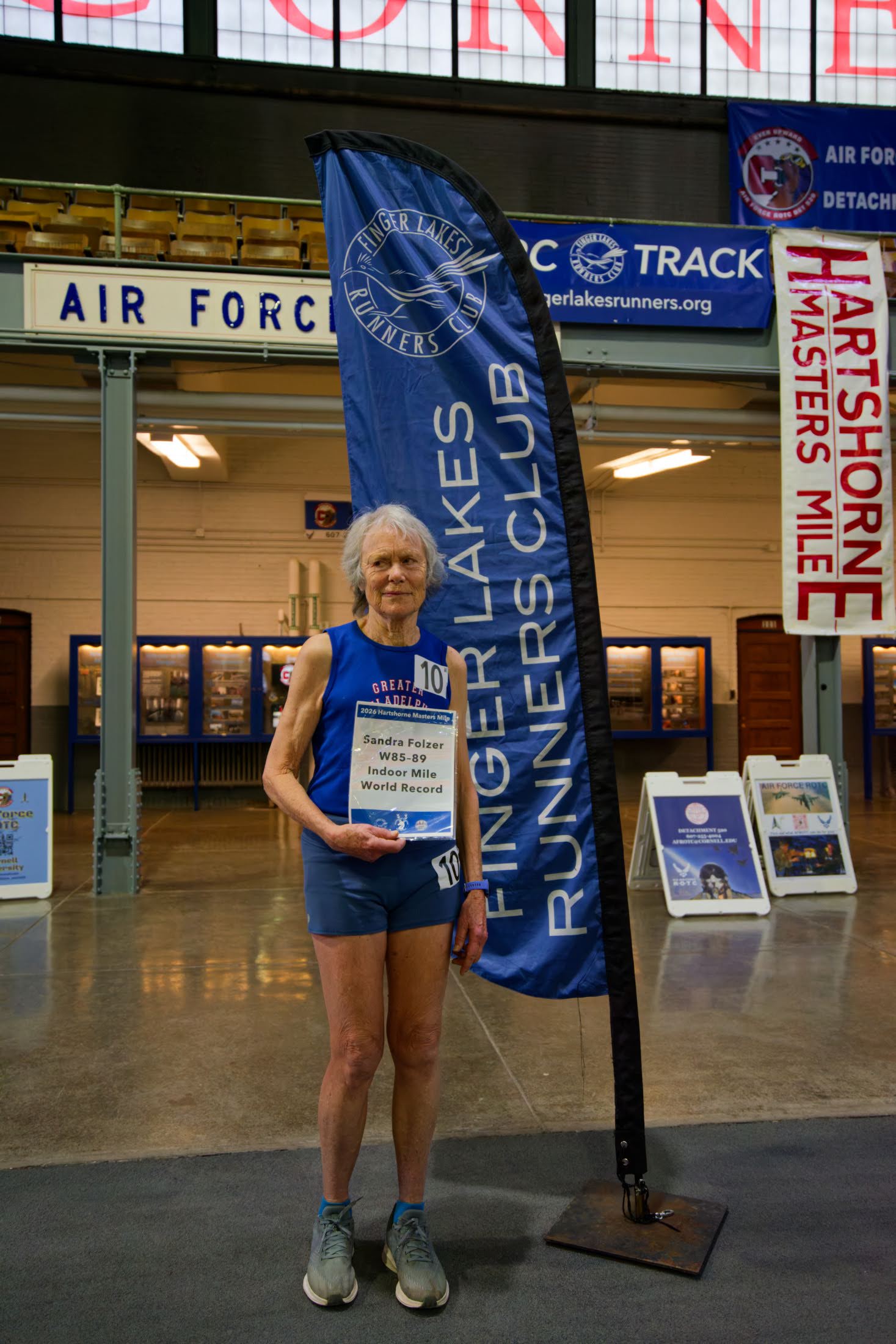
In the Combined Section 1 heat, 86-year-old Sandra Folzer improved on the W85 indoor mile world record she set at last year’s Hartshorne, running 9:43.00 to shave 2.24 seconds off her previous mark of 9:45.24. In the Women’s Elite heat, 60-year-old Michelle Rohl ran 5:29.05 for an astonishing 95.67% age-grade—the top mark of the day—to set a new W60 American record for the indoor mile, clipping almost two seconds off Suzanne McDonald’s 5:30.74 from 2021.

But that wasn’t all for Rohl, a three-time Olympian in the race walk and 1999 Pan American Games bronze medalist, who now holds 10 individual age-group American records in distances ranging from 800 to 10,000 meters. The next day at the USATF Niagara Indoor Championships, she shattered the W60 world record for the 3000m race walk with a 15:09.64, more than 30 seconds faster than the previous mark. For these performances, USATF named her Athlete of the Week. And her season is just getting started! Just one week later, she broke the W60 indoor mile world record with a 5:26.65 at the New Balance Indoor Grand Prix in Boston and was featured in Runner’s World.

Full results are available on the FLRC site, including age-grade percentages and times. Leone Timing’s results are also worth checking out for their split times and position changes. Don’t miss the great race photos and videos! (You can also click the header links below to watch the associated videos.)

Race Results

Combined Section 1: The opening heat of the day featured 17 runners spanning a wide age range. 52-year-old Amy Dawson won overall in 7:46.42, while 66-year-old Susan John was second for the women in 8:16.89, and 53-year-old Heide Van Buskirk was third in 9:07.67. For the men, 66-year-old Ted Limpert took first in 7:51.03, followed by 81-year-old John Leary in 8:08.40 and 67-year-old Anthony Boyadjis in 8:22.69. Although she was back in the pack, 86-year-old Sandra Folzer broke the W85 world record with a 9:43.00, surpassing her previous record of 9:45.24 set last year at Hartshorne. Meanwhile, 91-year-old Edna Hyer—a Hartshorne legend who has broken multiple records at this meet and was the oldest competitor—finished the race in 16:48.90.

Men’s Section 2: 64-year-old Neal Coffey led from the gun to take the win in 6:14.63, holding off 67-year-old Derrick Staley, who worked his way up to second after the 800 and finished in 6:20.01. James Dean, 53, claimed third in 6:25.54. The race featured a trio of strong 70+ performances: Spider Rossiter, 74, clocked an impressive 6:33.96; Ken Hodges, 72, came through in 6:58.07; and 75-year-old Tim Payne crossed in 7:39.38.

Women’s Section 2: 61-year-old Pamela Ricker led the race from the start to finish in 6:21.00, good for the fourth-best women’s age-grade of the day at 83.40%. Jeannette Boyd, 50, finished second in 6:25.87, while 45-year-old Laura Morse came in third at 6:30.55.

Men’s Section 3: 65-year-old Johnny King-Marino controlled the pace for most of the race, but 50-year-old Thomas Meyer took the lead with 400 meters to go and unleashed a 35.86-second final lap to take the win in 5:39.70. King-Marino held on for second place in 5:49.49. Michael Olson, 60, placed third in 5:54.71.

Men’s Elite B: With rabbit Patrick Milano pacing the race through the first 1200 meters, 42-year-old Dave Cook took control at 400 meters and ran strongly for the win in 4:51.01, recording the third-fastest lap of the day with a 31.45-second 200m kick. Jordan Varano, 46, finished second in 5:05.93. The race’s standout age-graded performance came from 60-year-old Benoit Hogue, third overall, who ran 5:08.10 for an 88.90% age-grade—second-best among all men for the day.

Women’s Elite: This heat featured the top women’s performances of the day. 50-year-old Sascha Scott, a five-time Hartshorne champion who has never been beaten at this race, tracked rabbit Bella Burda for the entire race to take the win in 5:18.15, earning a 90.78% age-grade. Olympic Marathon Trials qualifier Chelsea Benson, 43, in her first competitive mile in 20 years, finished second in 5:25.78 with an 83.99% age-grade. But the day’s best age-graded performance came from 60-year-old Michelle Rohl, whose third-place finish in 5:29.05 translated to an impressive 95.67% age-grade—a new W60 American record for the indoor mile. Anne Riordan, 41, placed fourth in 5:29.52, just 0.47 seconds behind Rohl, with Jennifer Boerner Selig, 43, close behind in fifth at 5:30.32. 39-year-old Donna Langerfeld took sixth in 5:41.92, with 48-year-old Alison Schwalm finishing seventh in 5:42.88. Liz Hartman, 43, crossed in 5:43.71, followed by college teammates Jennifer Perry, 45, in 5:49.76, and Erin Dewalt, 45, in 5:51.63. Katherine Durrant, 52, finished eleventh in 6:15.98, and 64-year-old Lorraine Jasper rounded out the heat with a 6:37.67.

Men’s Elite A: The final race of the day saw rabbit Alexander Simpson take the field out in 34-second laps, with 50-year-old Nick Conway tucking in behind him for the next six laps before 40-year-old Shaun Donegan made his move into the lead. From there, Donegan held off two-time Hartshorne champion Sam Morse, 42, with the fastest lap of the day—a blistering 30.05-second final 200m to Morse’s 31.18, the second-fastest lap of the meet—to win in 4:31.08. Morse finished second in 4:34.07, with Conway’s third-place finish in 4:34.70 converting to a stellar 91.76% age-grade, the top men’s mark of the day. William Hoyne, 43, was fourth in 4:42.80, followed by Chuck Terry, 43, in 4:48.00 and 51-year-old Mike Padilla in 4:48.98—Padilla’s time was good for the third-best men’s age-grade of the day at 87.90%. Louie DiNuzzo, 43, and George Young, 44, finished seventh and eighth in 4:50.69 and 4:52.05, respectively, with Peter Boyd, 51, rounding out the field in 5:04.75.

Volunteers

Hartshorne requires a significant volunteer effort, starting with race director Adam Engst and assistant directors Charlie Fay and Tom HartshorneLeo Nakaranuruck arrived early to help set up. Jim Miner and Rebecca Lambert managed the registration table, with Joanne Button taking over for the second shift and later helping with lunch check-in. Jesse Koennecke served as clerk of course, and Jan Hunsinger started all the races. Tonya Engst greeted and coordinated volunteers. Our speedy rabbits were Bella BurdaPatrick Milano, and Alexander SimpsonPaul Houle took photos, and Jorge Cuevas was our videographer. David Rossiter counted laps and rang the bell, Jon Lewis called splits to runners, and Rich Bernstein monitored the finish line. Joel CisneTom HartshorneTristan Lambert, and Aaron Proujansky helped keep spectators off the track during the races. Christine Sparfel assisted Marte Reps with on-site management of the award luncheon. Thanks to everyone involved!

Sponsors

Finally, we want to thank the sponsors who made this year’s Hartshorne possible. It takes a lot of money to host a national-level meet like this, including rabbits, race photos, race videos, a post-race banquet, and cash prizes to attract some of the top talent in the US and Canada. The race’s 2026 sponsors include Sean NicholsonJoe Daley, the Hartshorne FamilyJavier MartinezCayuga Health, and Bangs Ambulance. Also, thanks to Cornell University for allowing us to race in Barton Hall, the Cornell Track & Field Team for letting us compete before their meet, and Leone Timing for world-class timing services. The masters running community is tremendously grateful for their support. Just because we’re not so young anymore doesn’t mean we don’t take our racing seriously!

See you next year!

January Jicker Kicks Off the 2026 Track Season in Style

Our first track meet of 2026 is in the books! We hosted 191 athletes with 408 event participations from 9 teams, including the Mustangs Track Club, Groton Project TC, Troy Track & Field, North Penn-Mansfield, Odessa-Montour, GIAC Navigators, SOAR Running Club, Trumansburg Track Club, and the Syracuse Track Club. Among many great performances, athletes notched two new top-10 spots on the FLRC Track leaderboard: Chelsea Benson in the 5000m and Dafydd Williams in the long jump. Full results and a link to the fabulous meet photos are available on the FLRC website.

5000m

The 5000m opened the meet with a competitive field braving the 25 laps around Barton Hall. Although Shane Fraser led for the first half, Lucas Baker took over and pulled away for the win in 16:23, while Fraser secured second in 16:32. Steve Esposito rounded out the podium with a 16:44 showing. For the women, Chelsea Benson took first with an impressive 18:24 that moves her into fourth on the FLRC Track leaderboard, while Odessa-Montour’s Lexi Strobel followed in 26:04. Of special note, 13-year-old Alden Morseman turned in a remarkable 18:01 to finish seventh overall, while 77-year-old James Miner completed the distance in 31:54.

In the racewalking sub-competition, Matthew Wombacker led the way in 25:29, followed by Madigan White in 29:02 and Madison Tuttle in 29:18.

60m

The 60m dash featured an impressive 93 finishers across numerous heats. Dafydd Williams blazed to victory in 7.02 seconds, with the Mustangs Track Club’s Thando Shezi close behind in 7.08. Nicolo Christian claimed third with a 7.33 clocking. Among the women, Odessa-Montour’s Aspyn Skinner took top honors in 8.68, followed by the Groton Project’s Karson Mackey in 8.94 and 10-year-old Amari Morrone of the GIAC Navigators in 9.07.

The toddler heats were once again a crowd favorite, with 2-year-old Alexander Kozik completing his 60m toddle in 36.76 seconds, and fellow 2-year-olds Senyo Nti-Addae and Caspian Whetten following in 49.49 and 51.19.

1 Mile

The 1-mile run saw numerous lead changes after a slow first lap, but in the end, Alexander Simpson threw down an impressive kick to win in 4:25. While that time would rank seventh all-time on the FLRC Track leaderboard, Simpson already holds the top spot with his 4:19 from a previous meet. Brian Kenny followed in 4:35, with Alexander Evans just a tick behind in 4:36 for third. On the women’s side, Hailey Whetten claimed the win in 5:29, with 43-year-old Liz Hartman taking second in 5:47 and Cher Armstrong finishing third in 6:11.

The mile also showcased solid performances across the age spectrum. The Groton Project’s Scott Weeks, 53, turned in a strong 4:51 for seventh overall, nine-year-old Layne Johnson ran a 6:25, and 72-year-old Ken Hodges crossed in 7:05.

200m

The Mustangs Track Club’s Siyel Bowman flew to victory in the 200m with a 23.35 showing. Nicolo Christian grabbed second in 23.48 for his second top-three sprint finish of the day, while the Mustangs’ Thando Shezi—also doubling back from a podium finish in the 60m—rounded out the top three men in 24.33. Odessa-Montour’s Janne Anderson, just 14 years old, led the women with a 29.39 clocking. The Groton Project’s Karson Mackey claimed her second top-three sprint of the day with a 30.45, and Troy Track & Field’s Harper Lee, also 14, secured third in 31.72.

At 78 years young, Carl Feuer completed the 200m in 58.71, while 67-year-old Timothy Christian crossed in 38.40.

4x200m Relay

The college-aged Mustangs Track Club dominated the relay competition, taking first and second with times of 1:45 and 1:55. North Penn-Mansfield claimed third in 1:58, just ahead of Troy Track & Field in 1:59. All told, four teams broke the 2:00 barrier.

High Jump

Dylan Johns cleared 5 feet, 10 inches to win the high jump, with Kole Heyer reaching 5 feet, 8 inches for second and John Kerin jumping 5 feet, 6 inches for third. Among the women, North Penn-Mansfield’s Nora Furry led with a clearance of 4 feet, 4 inches, while the Mustangs Track Club’s Jaidon Brodie and North Penn-Mansfield’s Moira Wheeler tied for second at 4 feet, 2 inches.

Notable among the masters athletes, 65-year-old Mike Thompson cleared 4 feet, 6 inches, and the Syracuse Track Club’s Leander Boreland, 59, jumped 3 feet, 10 inches.

Long Jump

Dafydd Williams capped off a dominant day in the sprints and jumps, soaring to victory in the long jump with a mark of 20 feet, 7 inches—a result that vaults him into third place on the FLRC Track leaderboard. The Mustangs Track Club’s Siyel Bowman, also doubling back from his 200m win, landed second with 19 feet, 1¾ inches, and North Penn-Mansfield’s Brayden Johnson took third at 18 feet, 8½ inches.

In the women’s competition, 14-year-old Jenna Morningstar led the field with a jump of 14 feet, 5¾ inches. The Mustangs Track Club’s Jaidon Brodie claimed her second top-three field event finish of the day with 14 feet, 4 inches for second, and Troy Track & Field’s Harper Lee—notching her second top-three of the day after her 200m podium finish—took third at 13 feet, 5½ inches.

The youngest competitors also got in on the action, with 5-year-olds Oliver Nelson and Owen King, both of the SOAR Running Club, jumping 6 feet, 10½ inches and 6 feet, 10 inches, respectively.

Thanks to Our Volunteers

As always, FLRC track meets are the result of the efforts of numerous volunteers. Ian Golden, Lizzy Rayle, Dirk Swart, Robert Swizdor, and Bob Talda arrived early to help with setup. Tonya Engst managed the registration desk and answered questions with Rebecca Lambert. Patrick Boyle did a bang-up job as starter, and Bob Talda recorded all the times as head timer. Molly Doruska counted laps and ran the backup timer, while Chris Mellor recorded bib numbers for the longer races. Lizzy Rayle and David Rossiter coordinated the heats, and Jesse Koennecke kept HyTek Meet Manager running smoothly for results with help from Charlie Fay. Our sprint timing team consisted of Amy Dawson, Scott Dawson, Molly Doruska, Marlene Kwee, Christopher Petroff, and Robert Swizdor. On the field event side, Brett Shelton managed the long jump with assistance from Leo Nakaranuruck, Ted Boscia, and Ayla Maggard, while LJ Lansdowne coordinated the high jump with help from Phil Johnson. Paul Houle took photos, and Heather Cobb sold FLRC clothing.

Thanks for coming, and we’ll see you at the February Flash Dash and the Strides of March!

FLRC’s 2025 Accomplishments

One of FLRC’s primary goals is to provide opportunities for runners of all stripes, flavors, and persuasions. Whether you enjoy trails, roads, track, or cross-country, prefer social workouts or races, like to run by yourself or in large groups, or gain satisfaction from volunteering at an event, we have a place for you. Nowhere is that more evident than when we look back on what we accomplished together over the last year. 

The club had a fantastic 2025, hosting a race or a group run every weekend, along with a coached workout every Tuesday night, a series of Monday and Wednesday track workouts in the winter, a Couch to 5K program in the spring with biweekly Zone 2 and Chill group runs afterwards, and Thursday night Young at Heart social runs. Plus, FLRC members coordinated workshops on strength training, fascia release, and balance for runners, and we celebrated with various club parties. It all added up to an FLRC event roughly every other day over the entire year. We set an all-time record for race participation, our record-high club membership continues to flirt with the 1,000-member mark, and we ended the year in our strongest financial shape ever. All these accomplishments were made possible by volunteers—that is, by you!

Here are a few stats to give you a sense of the breadth and depth of FLRC’s accomplishments in 2025.

    • Races: For the first time in years, the weather allowed us to put on a full slate of races. We hosted 25 races during the year with a record number of 4,572 finishers from:
      • 9 trail races with 985 finishers (up 141 from last year)
      • 10 road races with 2,639 finishers (up 346)
      • 6 track meets with 948 finishers (down 44)
    • Group runs: We organized numerous group runs, workouts, and team events with nearly 3,800 participations for the year (up about 500 from last year), including:
      • 20 weeks of MITHACAL MILERS indoor track workouts with 1,197 participations (averaging 60 people per night with lots of kids as part of the Family Running Program)
      • 10 weeks of Monday/Wednesday winter track workouts for scholastic runners with an estimated 485 participations (averaging 27 per night)
      • 11 weeks of Summer Speed workouts with 335 participations (averaging 30)
      • 14 weeks of cross country workouts with 413 participations (averaging 30)
      • 10 FLRC Challenge group runs with 173 participations (averaging 17)
      • 8 weeks of Sunday Skunkday runs with 141 participations (averaging 18)
      • 28 weeks of Young at Heart group runs with 590 participations (averaging 21)
      • 7 weeks of Couch to 5K group runs with 91 participations (averaging 13)
      • 18 general group runs with 260 participations (averaging 14)
      • 105 attendees at the FLRC Annual Picnic in August
      • 3 weeks of the Happy Holidays Scavenger Hunt online game in December and January, generating oodles of amusing photos on the forum
  • Volunteers: FLRC exists solely because of its volunteers. Over the past two years, we’ve found the Helper Helper volunteer management system essential for coordinating and communicating with volunteers. It also makes it easy to pull out some astonishing stats. Impressive as these numbers are, they don’t include board meetings, committee meetings, club infrastructure work on equipment and merchandise, and informal discussions among club leaders. Race directors also invest significant amounts of time beyond what’s captured in Helper Helper.
    • 239 people volunteered for at least one FLRC event, and we had a great collection of super volunteers:
      • 46 people volunteered more than 12 hours (1 hour per month)
      • 16 people volunteered more than 24 hours last year (2 hours per month)
      • 8 people volunteered more than 48 hours last year (4 hours per month)
    • 2,400 hours volunteered (over 3 person-months!), including:
      • 502 hours for Finger Lakes 50s
      • 280 hours for Skunk Cabbage 
      • 137 hours for Trackapalooza
      • 132 hours for group runs and workouts
      • 116 hours for the Monster Marathon
      • 100 hours for an average indoor or outdoor track meet
      • 40 hours of timing non-FLRC races for the community
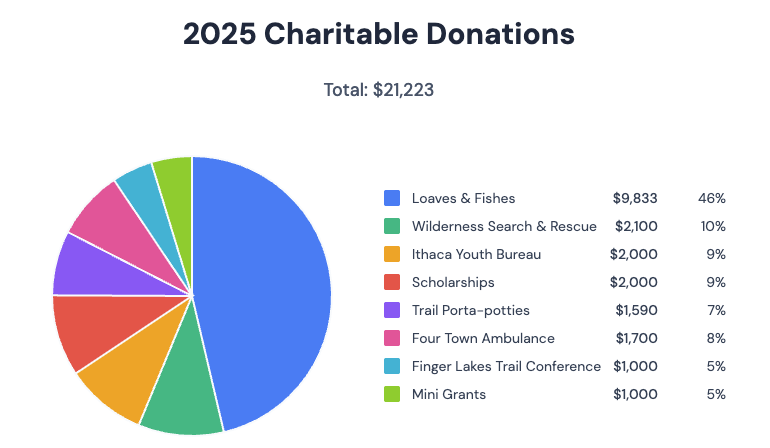
  • Donations: We donated or helped coordinate $21,223 in charitable donations, including:
    • $9,833 for Loaves & Fishes (through Turkey Trot donations)
    • $2,100 for Wilderness Search and Rescue (for helping at our trail races)
    • $2,000 for the Ithaca Youth Bureau track and cross-country programs
    • $2,000 in scholarships for two graduating high school seniors
    • $1,590 for porta-potties on the Black Diamond Trail and Hammond Hill
    • $1,700 for the Four Town Ambulance and First Aid (the profits of the Fillmore 5K)
    • $1,000 for the Finger Lakes Trail Conference (Finger Lakes Trail maintainers)
    • $1,000 in Mini Grants to the GirlStrong and Run Ithaca youth running programs


In addition, FLRC’s Timing Team helps out with four community races: the Cayuga Heights Elementary School 5K, the Belle-Sherman 5K, the World Caring Day 5K (Northeast/DeWitt), and the Easy as Pie 5K (Brooktondale Community Center). Our efforts helped those races raise a total of $12,226.

  • Fundraising: Although much of our donations are covered by race registration fees, we also offset some through direct community donations. Plus, generous track sponsors always make the Hartshorne Masters Mile possible. Thanks to everyone who donated!
    • $8,000 raised for the Hartshorne Masters Mile
    • $5,138 raised in donations during race and membership registrations
    • $1,800 raised in direct donations
    • $500 donated from our PGXC participation
    • $295 raised for the trail porta-potties

  • FLRC Challenge: In its fifth year, the FLRC Challenge once again provided local runners with structure for their running from April to September. Some stats from the leaderboard:
    • 157 signups, with 134 people completing at least one course
    • 101 completions
    • 3 completions of the FLRC 100K Ultra Challenge, 5 completions of the Tough Trail Challenge, and 7 completions of the Tough Tarmac Challenge
    • 2,449 total runs logged
    • 11,858 miles covered
    • 485 run report “star posts” from participants sharing with the community
    • $1,576 awarded across 200 prizes to 40 athletes
  • Cross-country: We coordinated FLRC and High Noon teams in the five-race PGXC series, placing third overall in the PGXC Club Cup rankings. Highlights included:
    • We fielded 91 runners and combined for 218 race participations for the season (up 15 runners, down 21 participations).
    • Cross country is as much about the food as the running! In addition to post-race group lunches across the state, we held pre- and post-season parties for about 30 people each.
    • We hosted a PGXC race at Treman State Park, welcoming 230 runners from Syracuse, Rochester, Buffalo, and other upstate areas. The 75-person FLRC/High Noon team outscored all the other teams handily.
    • FLRC’s women’s Vets and Ultra Vets won their divisions for the series, with the U19 and women’s Masters and Super Vets teams taking second. Our High Noon men’s teams took third for Open, Masters, and Vets.
    • FLRC’s Hailey Whetten won the PGXC series overall for the women, with Ryan Jacobsen winning the U19 division, Julie Barclay winning the women’s Vets division, and Anne Shakespeare winning the women’s Ultra Vets division. We also claimed numerous other top 10 spots.
  • Online presence: As much as we’re all about interacting in person, an online presence is essential in today’s world. Accomplishments include:
    • Grew the FLRC Forum to 1,583 members, up 216 from last year
    • Hosted 4,006 forum posts for the year
    • Racked up more than 186,000 page views by actual people on the forum
    • Increased the size of our photo library by 32 albums and over 7,500 photos (we’re moving the photo library to Google Photos this year)
  • Club governance: With hard work behind the scenes, we: 
    • Increased club membership from 935 last year to 955 at the end of 2025
    • Managed over $246,000 in assets, including $212,000 of investments that generate revenue to fund FLRC’s philanthropic efforts
    • Brought in two new board members to replace departing members and fill gaps in the board’s skills, experiences, and demographics

Let’s see what we can do together in 2026!

Forest Frolic 2025 Sees New Record for “Most Lostiest”

In the heart of Virgil, NY, where the trees whisper secrets and the trails twist like serpents through the undergrowth, two men emerged, not as mere mortals, but as stewards of the wild. Peter Dady (@tpdady) and Michael Stone (@me.runalot), Race Directors of Uncommon Resolve, ventured into the forest on the eve of the great run. The sun blazed overhead like a molten eye, casting down its fury upon the earth. The air was thick, oppressive, alive with the breath of the wilderness.

For six relentless hours, they toiled, placing nearly 600 purple flags like breadcrumbs for the brave souls who would follow. With chainsaw in hand, they carved a path through nature’s tangled defenses, felling fallen giants, trimming the grasping limbs of ancient trees, and banishing thorny sentinels that lay in wait for the ankles of the unwary.

Then came the dawn.

Sunday morning broke with a hush, as if the forest itself held its breath. The skies, once cruel, now softened. Clouds gathered like watchful guardians, and a gentle rain fell, neither too heavy nor too light, providing just the right amount of mud. It was not a hindrance, but a gift. For the Forest Frolic is a trail best run with a little wildness beneath the feet.

The 15K wave surged forth first, mostly veterans of the trail, their eyes sharp with memory and muscle. Thirteen minutes later, the 7K wave followed, mostly newcomers, wide-eyed and eager, stepping into the unknown with courage in their stride.

And amidst it all, three things stood out like fireflies in the dusk: the radiant smiles of first-time trail runners, the warm clasp of old friends, some we are meeting for the first time, and watching three generations of the Leonard family run side by side, embodying the spirit of community, bound by blood and the call of the trail.

Of note: Sarah Woodyear dominated the 7K, winning outright by a wide margin, even beating a swift 13-year-old. And in the 15K, Banyan’s victory over Chris Petroff dashed the tantalizing possibility of Chris achieving a Stonehead score evenly divisible by 100 from winning every race he ran. Still, Chris remains in the lead for Stonehead, is poised to win Pebblehead, and is currently tied with Steve Jesch for Boulderhead. We’ve never had a three-way winner. The tension builds.

But every tale has its twist.

On this day, a new record was set for the “Most Lostiest”. The name of the record holder will remain a secret, out of respect, and perhaps a touch of mystery. This intrepid soul paused for water at the powerline water stop, then veered off course, running a staggering 6.3 kilometers to the Parker Street Cemetery before calling for rescue. A feat of endurance, yes, but also a cautionary tale. Let it be known: when the trail marks vanish, do not press forward into the unknown. Turn back. Return to the last mark. Never, ever trust that the flags will simply reappear. The forest does not forgive such optimism.

This was no mere race. It was a rite of passage, a communion with the wild, and a testament to the enduring spirit of those who dare to run where the forest rules.

We await next year’s Frolic with cautious optimism. After all, we’ve endured sun so unbearable it made sunscreen beg for mercy, rain so biblical it changed the course of creeks, and mud, thick, relentless mud, that tested the limits of even the most seasoned veterans. We’ve had it all… except snow…

Write-up by race director Michael Stone.

Check out the 2025 race results and the updated FLRC Trail Circuit leaderboard. Also, peruse through the photos and feel welcome to upload yours to the community photo album.

Third Annual Trackapalooza Showcases Impressive Track and Field Performances

Our third Trackapalooza Invitational track meet was again a success, with glorious summer weather on the welcoming Groton High School track. Full results are now available, and don’t miss the fabulous meet photos from Paul Houle and Christopher Petroff—you’re welcome to download and share them. If you have any pictures of the meet, please upload them to our community photo album to share with others and document the day.

We hosted 157 athletes with 361 event participations, many from 6 teams, including the Groton Project Track Club, Ithaca Youth Bureau, Baldwinsville Harriers Track Club, Wyoming Elite Track Club, SOAR Running Club, and the Tompkins County Pole Vault Club, plus individual competitors from the Syracuse Chargers, the Syracuse Track Club, the Trumansburg Track Club, and Southern Cayuga.

Field events were made possible once again through partnerships. Matt Scheffler of the Tompkins County Pole Vault Club managed the pole vault. Brett Shelton of the SOAR Running Club officiated the long jump and the triple jump, with his fellow coach Steve Wagner managing the high jump. The Groton Project’s Sean Shea coordinated the shot put and discus. Special thanks to Scott Weeks and Groton High School for allowing us to use their facilities and equipment!

On to the results! Among all the other great performances, three field event athletes took over the top spots on the FLRC Track leaderboard: Dominic Mikula and Katherine Scheffler in the pole vault and Ariana Hillery in the shot put.

100m

The 100m dash saw Daniel Mars storm to victory in 11.00 seconds, with Chris Zellar of the Baldwinsville Harriers following in 11.15 and Aedan Pitoniak rounding out the top three in 11.32. In the women’s competition, the Groton Project’s Truth Snyder, just 13 years old, led the field in 13.36, with Harper Frederick of the Wyoming Elite Track Club just behind in 13.38. The Groton Project’s Reilly Quinn secured third in 13.61.

On the other end of the time spectrum, Theo Milano celebrated joining the 2-year-old age group by dropping more than 50 seconds from his 100m toddle time in 2:02, and sisters Cordelia (1) and Rebecca Gorges (2) finished together in 2:45.

100m Hurdles

In our first-ever 100m hurdles for women, the Groton Project’s Karson Mackey took the win in 17.21, followed closely by Evelyn Jackson of the Tompkins County Pole Vault Club. Amelia Petersen of the Groton Project rounded out the podium in 17.95. Props to 8-year-old Carmina Mahony Glann of the Groton Project for completing the challenging event over age-appropriate hurdles in 28.28.

110m Hurdles

In a head-to-head race for the men’s 110m hurdles, Aidan Tierney claimed victory in 17.60, while the Groton Project’s Kholton Reynolds crossed second in 20.36. It’s not as easy as it looks!

200m

Daniel Mars doubled up with another victory in the 200m, clocking 22.89 seconds. Aedan Pitoniak again showed his speed with a 23.77 second-place finish, while the Groton Project’s Derran Morris took third in 23.81. For the women, Kadence Barton crossed first in 27.39, with the Groton Project’s Reilly Quinn following in 28.73. Harper Frederick of the Wyoming Elite Track Club completed the podium in 28.97.

400m

The 400m saw the Baldwinsville Harriers dominate, with Chris Zellar winning in 53.92 and teammate Rex Kirkegaard taking second in 55.96. Chris Rogers rounded out the podium with a 57.62 showing. In the women’s race, Kadence Barton secured her second win of the day in 1:02.87, while Reagan Burnham took second in 1:08.16. Lexi Peiffer of the Wyoming Elite Track Club claimed third in 1:10.27. Notably, 74-year-old Coreen Steinbach, a regular on the world masters track stage, turned in an impressive performance with her 1:26.58, good for a national-class age-grading percentage of 83.84%.

800m

In a toasty 800m, the final individual race of the day, Paul Hayden took the win handily in 2:07, with Patrick Milano following in 2:16 and Daniel Zhang claiming third in 2:26. For the women, 43-year-old Liz Hartman dominated with a 2:36 victory, notching an adult personal best. Second place went to 11-year-old Lucia Camacho Murillo of the Ithaca Youth Bureau in 3:53, followed by Linda Mahoney of the Groton Project in 3:59. 66-year-old Casey Carlstrom impressed with a 2:35 showing in the men’s race, good for sixth overall and a national-class age-grading percentage of 84.55%.

1600m

In the 1600m, Lucas Baker ran alone the entire race to place first in 4:29, followed by Patrick Milano in 4:56 and the Groton Project’s Zachary Arria in 5:06. Liz Hartman continued her strong day by winning the women’s race in 5:42, tying her PR for second all-time on the leaderboard. The Groton Project’s Alison Belcher, just 12 years old, took an impressive second in 5:59, while her 11-year-old sister and teammate Lauren Belcher crossed in 7:55 for third. 72-year-old Ken Hodges finished in 6:56 to qualify for the coveted “breaking 7 at 70” club, also a national-class effort with an age-grading percentage of 82.3%.

5000m

Much of the 5000m was a tight three-man race, with the lead changing hands multiple times. With 200m to go, Alexander Simpson unleashed a fearsome kick, putting 10 seconds on Brady Burrough in the last half lap to win in 15:57 to Burrough’s 16:07. James Felice wasn’t far behind in 16:16. For the women, Sarah Woodyear led from the start to clock an 18:40 win, while Margaret McLoughlin followed in 19:02. Third place went to 15-year-old Madigan White in 23:29.

4×200m Relay

The meet concluded with some fast relays, where the Baldwinsville Harriers team, anchored by Chris Zellar, dominated with a time of 1:36 that tied our fastest relay time of the year. With Sebastian Bartischevich bringing it home, The Speedsters took second in 1:51, just ahead of an unattached team anchored by Derran Morris in 1:52. Patrick Milano anchored The 3s to fourth in 1:54, making for a tight finish with just 3 seconds separating second through fourth place.

Long Jump

In the long jump, 47-year-old Samitha Samaranayake leaped to victory with a 19 feet, 7¾ inches mark, sneaking into tenth place on the leaderboard. Will Boscia and the Groton Project’s Tom Pinkowski tied for second at 19 feet, 1 inch. In the women’s competition, Kadence Barton claimed her third win of the day with a 16 feet, 6½ inches jump, the Groton Project’s Reilly Quinn was close behind with 16 feet, 2 inches, and Raelen Green secured third at 15 feet, 11 inches.

Triple Jump

The Groton Project’s Tom Pinkowski bounded to an uncontested win with a hop, skip, and jump of 41 feet, 1 inch in the triple jump, improving his distance while maintaining second place on the leaderboard. On the women’s side, Alyssa Johnston took first with a leap of 31 feet, ½ inch, just edging out Kadence Barton’s 30 feet, 11 inches. Darby Stetter secured third with 26 feet, 6 inches. 62-year-old Karen Ellsworth of the Syracuse Chargers impressed with a jump of 18 feet, 10¾ inches.

High Jump

In the high jump, Rex Kirkegaard of the Baldwinsville Harriers and Alix Aviles tied for the win (and tenth place on the leaderboard) at 5 feet, 8 inches, with Brady Burrough and Brayden Westbrook sharing third at 5 feet, 6 inches. For the women, the Groton Project’s Kristen Johnston cleared 4 feet, 10 inches for the win (though not up to her top spot on the leaderboard from last year), while Samantha White took second at 4 feet, 6 inches (sixth on the leaderboard) and Darby Stetter placed third at 4 feet, 2 inches.

Pole Vault

In FLRC’s second-ever pole vault competition, the Tompkins County Pole Vault Club athletes took five of the top six places. Dominic Mikula dominated with a clearance of 15 feet, 7 inches, moving into an uncontested first place overall atop the leaderboard. Nathan Fromme, the only top place not part of the TCPVC, cleared 12 feet for second, while Noah McKibben was third (but fourth overall) in 11 feet. Among the women, Katherine Scheffler cleared 11 feet, 6 inches for first place and third overall—it’s also the top mark on the leaderboard. Alyssa Kelleher and Evelyn Jackson tied for second among women at 10 feet—those results also put them second on the leaderboard.

Shot Put

Although not equal to his top spot on the leaderboard, Matt Funicelli dominated the shot put with a throw of 49 feet, 5 inches, nearly 15 feet ahead of second-place Camden Davis of the Baldwinsville Harriers, who threw 35 feet, 1½ inches to claim ninth on the leaderboard. The Syracuse Track Club’s Leander Boreland took third with 34 feet, 7 inches. For the women, the Groton Project’s Ariana Hillery won with a 29 feet, 6¾ inches throw to claim first place on the leaderboard, unseating her teammate Kristen Johnston, who took second with 25 feet, 7 inches, and the Wyoming Elite Track Club’s Brooklyn Evans claimed third with 23 feet, 2¼ inches, good for tenth on the leaderboard.

Discus

Again not quite reaching his previous second-place leaderboard effort, Matt Funicelli still completed the throws double with a discus toss of 142 feet, 5¾ inches, more than 23 feet ahead of Brody Williams, who claimed second with a throw of 119 feet, 4 inches. The Syracuse Track Club’s Leander Boreland took third with 109 feet, 5½ inches, good for eighth on the leaderboard. The Groton Project’s Ariana Hillery again led the women with a throw of 77 feet, 7½ inches, which moved her from fifth to fourth on the leaderboard. The Syracuse Chargers’ Karen Ellsworth followed her with 63 feet, 1 inch, and the Wyoming Elite Track Club’s Brooklyn Evans placed third with a throw of 43 feet, 2½ inches.

Volunteers

As always, FLRC track meets are the result of the efforts of numerous volunteers. Thanks to Tonya Engst for helping prepare for the meet the day before and then managing bib pickup, ably assisted by Mary Catt. Scott Weeks of the Groton Project coordinated everything with Groton High School. Dave Kania, Jesse Koennecke, Bob Talda, and Carl Franck helped with setup. Patrick Boyle did a bang-up job as starter, and Bob Talda recorded all the times as head timer, Jesse Koennecke and Dave Kania reseeded heats and produced results, and Heather Cobb and Jon Lewis coordinated the heats. Christopher Petroff counted laps and recorded bib numbers for the longer races. We had lane timing assistance from Keith Eggleston, Amy Dawson, Scott Dawson, Eugene Gonzalez, and Kim Jackson, with Ricky Stewart providing backup timing. On the field event side, Gregory Green, Tevin Smith, and Carl Franck assisted Brett Shelton with the long and triple jumps. Lizzy Rayle and Hamza Abdush-Shahid helped Steve Wagner with the high jump. Matt Scheffler managed the pole vault, and Janice Carter and Michelle VanEtten assisted Sean Shea with the throws. Laurel Gilmer sold FLRC clothing, and Lauren Milano brought muffins!
See you all in 2026 at the January Jicker!


Inaugural Sunset Circuits Track Meet Sees Three FLRC Track Leaderboard Bests

We kicked off our outdoor track season with the first Sunset Circuits meet last Tuesday at Groton High School. Among lots of great races and field events, competitors set three new bests on the FLRC Track leaderboard. In the 200m, 16-year-old Logan Aman ran a 22.26 to edge out Michael Durski’s 22.42 from 2023. In the 1600m, 22-year-old Alexander Simpson crossed the line in 4:20 to break his previous FLRC record of 4:25, set in 2024. And as the light dimmed at the end of the meet, 17-year-old Paul Busby cleared 6 feet, 4 inches, exceeding the previous record of 6 feet, 2 inches shared by Dylan Johns and Joey McDonald from 2024.
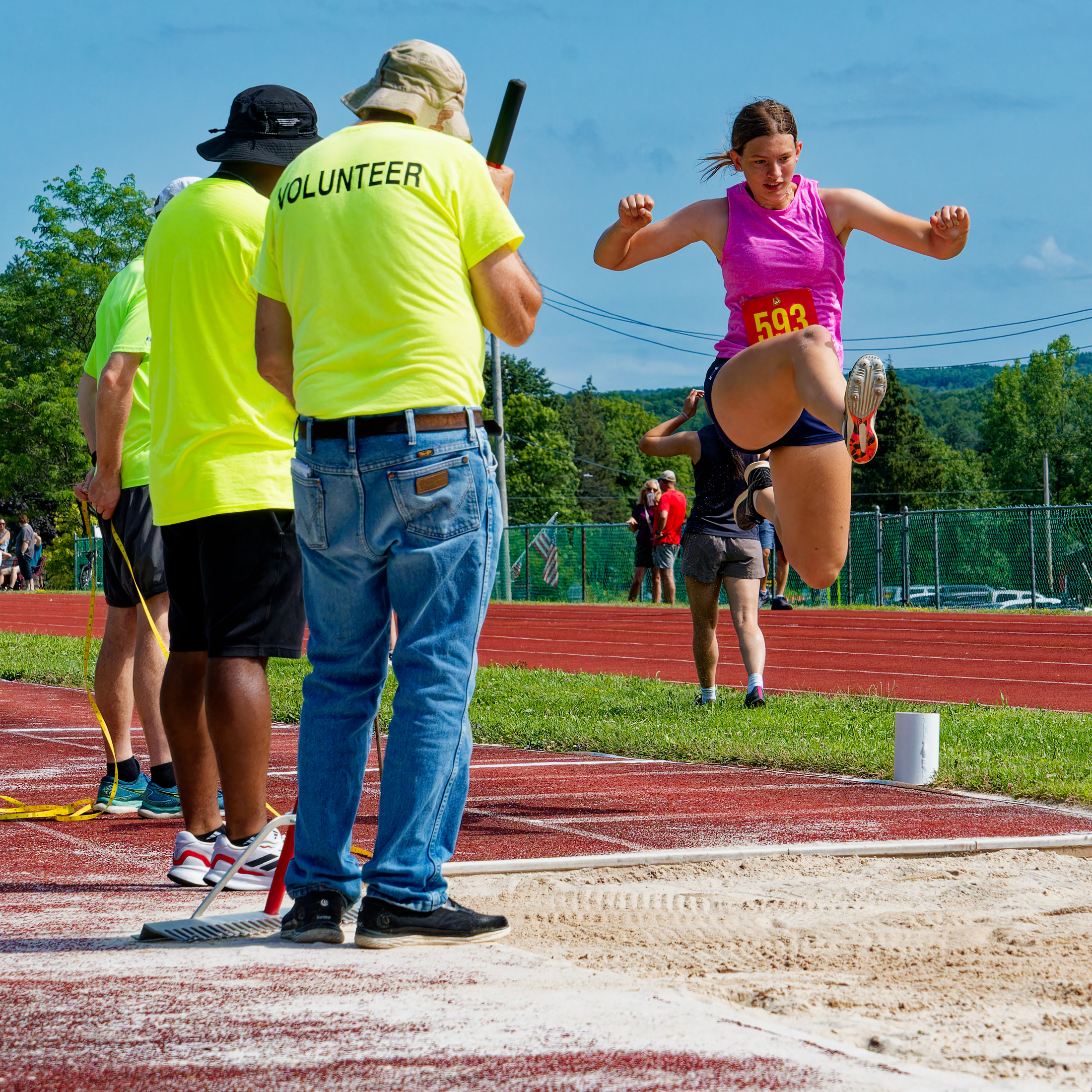
Full results are now available, and you can look through the great meet photos from Kristen Johnston. Please share your best photos too!

200m

The 200m saw another victory for Logan Aman, who crossed the finish line in 22.26 seconds, setting a new FLRC Track leaderboard record. Team Montrose’s Nico Christian was second in 22.91, swapping places with his teammate Maximus Kuwaye, who crossed in 23.74.

Among

100m

In the 100m dash, Logan Aman took the top spot with a blistering 10.82 seconds, good for third on the FLRC Track leaderboardMaximus Kuwaye from Team Montrose followed with a solid 11.27, just ahead of his teammate Nico Christian, who clocked in at 11.48.

In the women’s competition, Reilly Quinn from the Groton Project led with 13.79 seconds, followed closely by Vivian Welmon and Samatha White in 13.84 and 14.00.

the female sprinters, Samatha White dominated with a time of 29.80 seconds. Vivian Welmon finished second again at 30.11, and Adaline Jackson from the SOAR Running Club took third with a time of 36.02.

400m

In the 400m race, Charlie Hilbert pulled away to victory with a time of 54.57 seconds, followed by Noah Steinorth in 55.05, with Chris West rounding out the top three men with 56.28.

In the women’s field, Maysie Davis led with a time of 1:10.26, followed by Isabella Santos in 1:13.51, and Vivian Welmon taking third in 1:14.70 for her third podium finish of the night.

1600m

In the 1600m, Alexander Simpson dominated with a time of 4:20. The Groton Project’s Ross Bush, fresh off a 14th place in the 800m in the New York State Outdoor Track Championships, secured second place in 4:27, and Lucas Baker finished third in 4:28. These results were impressive enough to be mirrored by the top three spots on the FLRC Track leaderboard.

For the women, 43-year-old Liz Hartman won the race in 5:42, which was both a PR for her and speedy enough to move her into second place on the FLRC Track leaderboard. Second place was claimed by 12-year-old Alison Belcher from the Groton Project in 5:57, and third by Frances Steen, who finished in 6:13.

4x200m Relay

The 4x200m relay was a team triumph for Team Montrose, whose anchor Nico Christian came through in a blazingly fast 1:36, the fastest 4×200m time of 2025. Ross Bush anchored the Groton Project team to second place in 1:40, and Coach D and Minions wrapped up the top three with a time of 1:49.

High Jump

For the high jump, Paul Busby set a new FLRC Track leaderboard best with a leap of 6 feet, 4 inches. The Groton Project’s Tanner Mott finished second by clearing 4 feet, 8 inches, and his teammate Suansian Songput jumped 4 feet, 6 inches for third place for the men.

In the women’s category, Reilly Quinn of the Groton Project led with her jump of 4 feet, 10 inches. Samatha White and Carlea Davis both cleared 4 feet, 6 inches, tying for second.

Long Jump

In the long jump, Charlie Hilbert led with a jump of 19 feet, 9.5 inches. Tom Pinkowski and Maximus Kuwaye tied for second, both achieving a distance of 19 feet, 1.75 inches for the Groton Project and Team Montrose, respectively.

Among the women, Carlea Davis jumped the farthest at 16 feet, 10.5 inches. The Groton Project’s Reilly Quinn followed with 15 feet, 7.75 inches, while her teammate Mariel Bode secured third with 13 feet, 0 inches.

Discus

In the discus, David Shea of the Groton Project claimed first place with a throw of 104-10. 58-year-old Leander Boreland followed with 102-00, and Kenny Macumber rounded out the top three with a 92-06 toss.

In the women’s discus circle, 49-year-old Janice Carter from the Groton Project led with a throw of 88-10, followed by 62-year-old Karen Ellsworth of the Syracuse Chargers at 68-02.50, and Maysie Davis took third with 58-07.

Shot Put

Finally, in the shot put, the places matched those in the discus. David Shea once again took the lead with a throw of 37-05.25. Leander Boreland followed with a 35-10.50, and Kenny Macumber took third with a distance of 30-03.

For the women, Maysie Davis led with a throw of 26-07. Karen Ellsworth of the Syracuse Chargers took second with 24-11.50, and Carlea Davis was close behind in third with a throw of 24-03.50.

Thanks to Our Volunteers

Kudos to our volunteers for making the meet a success. Tonya EngstCarl Franck, Janice Carter, and Jesse Koennecke arrived early to help with setup. Tonya continued to manage the registration desk and answer questions alongside Rebecca LambertPatrick Boyle did a bang-up job as our starter, Bob Talda served as head timer, and Rich Bernstein and Julie Barclay coordinated the heats. Jesse Koenecke and Dave Kania kept HyTek Meet Manager running smoothly for results, Keith Eggleston recorded bib numbers for the 1600m and relay, and Ricky Stewart ran the backup timer. Our sprint timing team consisted of Brian Belcher, Nicole Belcher, Paula Klaben, Laura Morse, and Ian WoodsKristen Johnston took tons of great photos. Special thanks to Steve Wagner of the SOAR Running Club for overseeing the high jumps with help from Lungawm Songput, to Brett Shelton of SOAR for the long jump with support from Carl Franck and Linda Mahoney, and to Sean Shea of the Groton Project and his helpers for putting on the discus and shot put.